
Rity architecture of West Asia rested upon what scholars came to describe as Pax Americana - a regional order underwritten by American military power, strategic alliances and political influence. It protected vital energy routes, reassured allies and deterred conventional interstate wars. Yet it neither prevented repeated regional conflicts nor resolved the underlying political disputes that have kept the Middle East in recurring instability.
The recent war in Iran has exposed the limitations of that security model. Despite overwhelming military superiority, the conflict failed to produce a decisive political settlement. Instead, it disturbed global energy markets, threatened freedom of navigation in the Strait of Hormuz, damaged regional economies and ultimately compelled the protagonists to return to diplomacy.
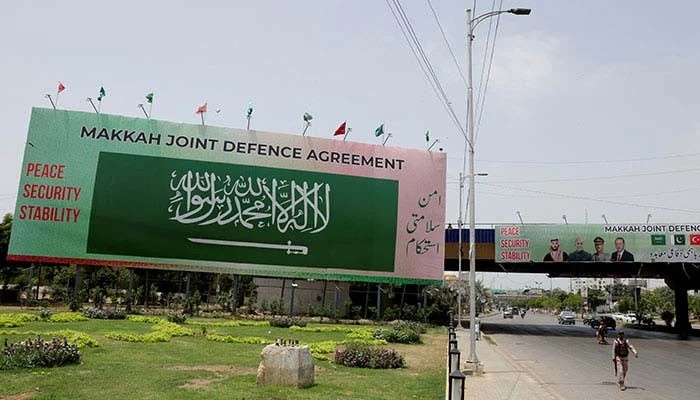
That experience has prompted an important strategic question: is West Asia gradually moving beyond Pax Americana towards a more regionally owned security order? Against this backdrop, the Makkah Joint Defence Agreement signed by Pakistan, Saudi Arabia and Turkiye deserves attention not simply as another defence pact but as a possible indicator of a wider geopolitical transition in West Asia. The question is whether the agreement would contribute to stability and peace or prove yet another barrier between the antagonists.
The agreement contains a collective defence commitment under which an armed attack against one member will be regarded as an attack against all. More importantly, it institutionalises cooperation in maritime security, defence production, intelligence sharing, cybersecurity and counterterrorism. Its architects argue that regional countries must increasingly assume greater responsibility for their own security while continuing constructive partnerships with the wider international community.
Significantly, Saudi officials have rejected descriptions of the pact as a 'Muslim Nato' or an anti-Iran alliance. Instead, the agreement has been described as a defensive arrangement intended to strengthen deterrence, safeguard sovereignty and contribute to regional stability. Saudi Arabia has also emphasised that it supplements rather than replaces existing strategic partnerships, including those with the United States.
Equally noteworthy has been Iran's restrained response. Rather than denouncing the agreement, Tehran has indicated that it sees no reason to fear the pact, suggesting that "regional security arrangements are acceptable so long as they are not directed against any particular country". Whether this measured response reflects tactical diplomacy or a wider reassessment remains to be seen.
However, given Pakistan's close relations with Iran, the former must have kept Iran in the loop. Nevertheless, it has reduced immediate concerns that the agreement could trigger another cycle of regional polarisation. Not everyone, however, views the development through the same lens.
Israeli strategic commentary has interpreted the pact as a potential geopolitical challenge, arguing that it may gradually reshape regional politics and reduce Israel's ability to dominate Washington's Middle East agenda. No doubt, the agreement would act as a deterrent to Israeli objectives of dominating the region. Whether this assessment proves accurate remains to be seen, although strategic agreements are judged not only by the intentions of their signatories but also by how they are perceived in other capitals.
India has adopted a cautious posture, limiting itself to observing developments. Still, Indian analysts call it a diplomatic success for Pakistan. However, India's restraint at the official level reflects New Delhi's increasingly complex strategic calculus.
India enjoys close relations with Israel, broadening partnerships with Saudi Arabia and the Gulf states, longstanding ties with Iran and major interests in regional connectivity. Therefore, India will carefully weigh its options in the evolving situation. One also has to carefully watch Washington and Beijing's reaction.
The US must now determine whether the Makkah Pact represents a welcome example of regional partners assuming greater responsibility for their own security or the beginning of a strategic evolution that may gradually reduce America's central role in regional affairs. The agreement itself appears designed to avoid such a confrontation by explicitly presenting itself as complementary rather than competitive. China's position will also be closely watched.
Beijing has consistently advocated political dialogue, regional ownership of security and economic connectivity. A framework that promotes maritime stability, protects energy routes and reduces regional tensions would broadly align with China's long-standing approach to the Middle East. Yet Beijing, like Washington, will probably judge the agreement less by its stated intentions than by its practical evolution.