
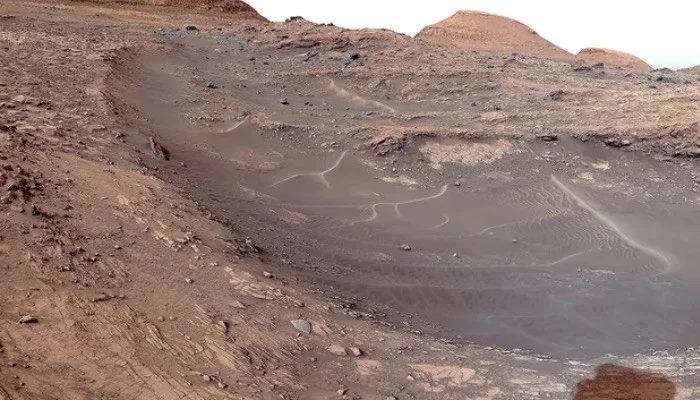
NASA's Curiosity rover discovered a vast field of pure sulfur rocks on Mars, according to research findings published throughout 2026. Curiosity rover identified pure sulfur deposits.
- Researchers dated the formations to 3.1 to 2.8 billion years ago.
- Discovery of Pure Sulfur: A team led by Scott VanBommel of Washington University in St.
- This physical characteristic suggested to researchers that the rocks formed exactly where the rover found them.
Researchers dated the formations to 3.1 to 2.8 billion years ago. Chemical processes, not life, likely created the crystals.
Discovery of Pure Sulfur: A team led by Scott VanBommel of Washington University in St. Louis confirmed the presence of remarkably pure sulfur spread across a wide area on the Martian surface. The study, published in the journal Science in June 2026, noted that the rocks were fragile and broke easily under the weight of the Curiosity rover.
This physical characteristic suggested to researchers that the rocks formed exactly where the rover found them. The research team proposed that ancient volcanic gases became trapped underground, potentially within ice structures known as clathrates.
As erosion carved out the channel where the rover traveled, these gases were released. The team theorized that chemical reactions among these gases produced pure sulfur without the need for high temperatures.
They estimated that this specific deposit formed between 3.1 and 2.8 billion years ago. Alternative Formation Theories: A second study, published in Geophysical Research Letters in July 2026, provided further insight into how these crystals developed.
Led by Jiawei Wang of Cornell University, this research demonstrated that mixing dissolved sulfide with chlorate in acidic water at room temperature could produce tiny sulfur crystals. This finding confirmed that the presence of living organisms was not a requirement for the creation of these deposits.
Environmental Context on Mars: While sulfur is an essential element for all known life, neither the study led by VanBommel nor the research led by Wang pointed to evidence of biological activity on Mars. Instead, the findings offered a clearer picture of the ancient Martian environment.
The data helped scientists understand how specific rock formations survived for billions of years while remaining nearly unchanged. The reports, released on November 16, 2026, provided a detailed look at the geological history of the planet and the chemical processes that shaped its surface during that era.