
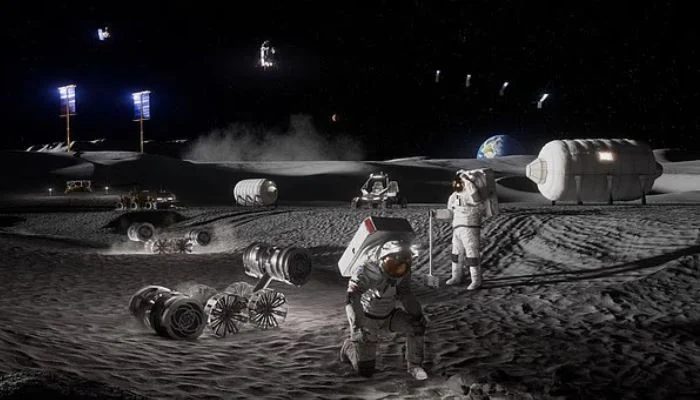
The National Aeronautics and Space Administration (NASA) is moving ahead with its ambitious $20 NASA on November 7 announced new contracts to accelerate construction of the lunar base, including a $10 billion framework for delivering equipment to the Moon.
- The space agency has divided the construction process into three phases.
- Interestingly, NASA is building a nuclear-powered rover named PROMISE using components from its Curiosity and Perseverance Mars rovers.
- Between 2029 and 2032, NASA will begin installing power stations, communication systems, and early habitation modules.
The space agency has divided the construction process into three phases. During the first phase, which runs until 2029, NASA will deploy robotic rovers and flying drones to identify suitable locations for construction and look for resources, including water ice.
Interestingly, NASA is building a nuclear-powered rover named PROMISE using components from its Curiosity and Perseverance Mars rovers. The six-wheeled vehicle, expected to launch in late 2028, will drill approximately three feet beneath the lunar surface in search of ice.
Between 2029 and 2032, NASA will begin installing power stations, communication systems, and early habitation modules. Japan is also developing a pressurized rover that will essentially serve as a mobile home, allowing astronauts to undertake expeditions lasting up to 28 days without having to wear spacesuits inside the vehicle.
The third phase, beginning in 2032, will see the construction of interconnected habitats for long-term human occupation. The lunar settlement will eventually serve as a testing ground for humanity's first crewed mission to Mars.
This project represents a significant shift in space exploration strategy, moving from short-term visits to sustainable presence. By establishing a base, NASA aims to utilize lunar resources to support deeper space travel.
International collaboration remains a key pillar of this mission, with various global partners contributing technology and expertise to ensure the success of the lunar infrastructure. As the 2032 deadline approaches, the global scientific community is watching closely, anticipating that this lunar city will unlock new frontiers in physics, geology, and human biology.
The success of this mission could redefine the future of space travel, making the Moon a vital hub for future interplanetary exploration. Related: