
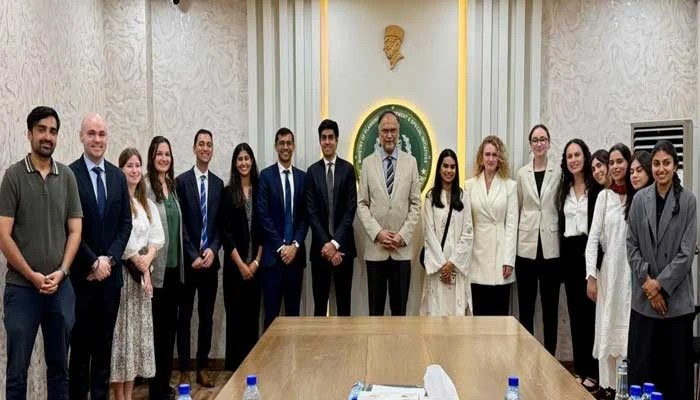
Federal Minister for Planning, Development and Special Initiatives Ahsan Iqbal has said that Pakistan's central economic challenge is to convert macroeconomic stability into sustained growth, higher productivity, exports, investment and employment.
"Pakistan should not be viewed merely through the prism of its challenges, but through the scale of its underlying potential. With a population of nearly 260 million, a large youth cohort, strategic geographic location, considerable agricultural and mineral resources, an expanding digital economy and a strong global diaspora, Pakistan possesses significant foundations for long-term economic transformation," the federal minister said while addressing a visiting delegation of Harvard Business School MBA students on Friday.
Welcoming the Harvard Business School students to the Ministry of Planning and Development, Iqbal said Pakistan must break the recurring cycle of boom, external account pressure, stabilisation and slowdown by restructuring the economy around productivity and exports. "Stabilisation is necessary, but stabilisation alone is not development. Pakistan cannot austerity its way to prosperity. We have to earn our prosperity through productivity, innovation, investment and exports," he added.
The minister briefed the students on URAAN Pakistan, the government's national transformation framework built around the 5Es: exports, enterprise and employment; e-Pakistan and the digital economy; environment, climate change, food and water security; energy and infrastructure; and equity, ethics and empowerment.
Pakistan, Iqbal further said, has set the ambition of becoming a $1 trillion economy by 2035, but stressed that the objective was not simply to achieve a numerical GDP target. "The real question is what Pakistan will be capable of producing and selling competitively to the world in 2035 that it cannot produce today. Development is ultimately about building national capabilities," he said.