
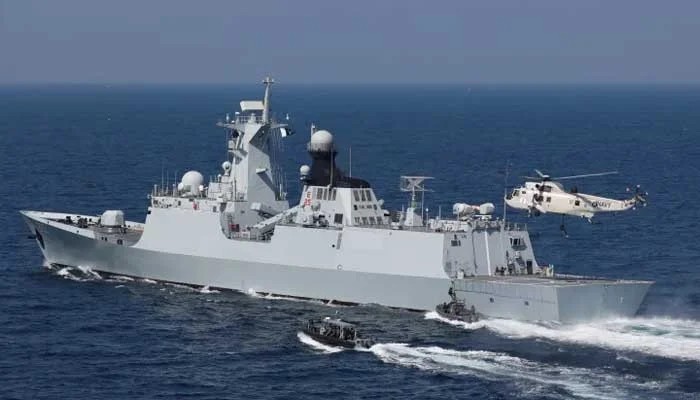
Every year on September 6, Pakistan observes Defence of Pakistan Day to honour the courage, sacrifice and determination of those who defended the country in 1965 and to reaffirm the nation's commitment to safeguarding its sovereignty. While the battles on land and in the air remain prominent in national memory, Pakistan's maritime front was also an important dimension of the conflict. Pakistan Navy demonstrated that effective maritime power could contribute significantly to national defence even when operating against a numerically stronger adversary.
The naval dimension of the 1965 war remains an important chapter in Pakistan Navy's history. The operation against Dwarka demonstrated operational resolve and highlighted the strategic importance of maritime preparedness. More importantly, the conflict reinforced a lesson that remains relevant today: Pakistan's defence cannot be viewed exclusively through its land borders.
The Arabian Sea and the wider Indian Ocean are equally important components of national security. Defence Day, therefore, provides an opportunity not only to remember the courage of the past but also to examine how Pakistan's maritime responsibilities have evolved. Today, Pakistan's security and economic prosperity are increasingly connected with the sea.
Its coastline, ports, Exclusive Economic Zone, maritime infrastructure and sea lines of communication constitute vital national interests. A substantial portion of Pakistan's international trade is transported by sea, making maritime security directly relevant to economic stability and national resilience. The Pakistan Navy therefore carries the responsibility of safeguarding the maritime frontiers while contributing to the protection of shipping, ports and critical maritime infrastructure.
Pakistan Navy's responsibilities have also expanded beyond conventional warfare. Piracy, terrorism, trafficking, maritime crime and threats to commercial shipping have transformed the security environment at sea. Maintaining maritime domain awareness, ensuring freedom of navigation and contributing to the security of sea lanes have consequently become important elements of naval operations.
Pakistan Navy's participation in multinational exercises and maritime-security initiatives further contributes to interoperability, professional cooperation and stability across the wider Indian Ocean Region. Operational readiness remains at the heart of these responsibilities. Over the years, Pakistan Navy has progressively modernised its capabilities through the induction of new surface ships, submarines, aviation assets, sensors, weapons and supporting systems.
A particularly significant milestone in this transformation is the induction of the new Hangor-class submarines. The commissioning of the first Hangor-class submarine represents an important step in strengthening Pakistan Navy's undersea warfare capability and maintaining a credible maritime deterrent. Equipped with modern technologies and designed for operations in an increasingly contested maritime environment, the Hangor-class programme reflects the Navy's emphasis on modernisation, survivability and enhanced operational effectiveness.
Together with modern frigates, maritime aviation and other fleet assets, these capabilities will strengthen Pakistan Navy's ability to safeguard national maritime interests across the spectrum of conflict. Pakistan Navy's contribution to national development, however, extends beyond its warfighting role. Search and rescue, humanitarian assistance, disaster relief, hydrography, maritime safety and support to coastal communities represent important aspects of its wider responsibilities.
Hydrographic surveys and navigational information support safe shipping and the development of Pakistan's ports and maritime infrastructure. Such activities demonstrate that maritime security is not merely a military requirement; it is closely connected with trade, economic development and the wellbeing of coastal communities. Looking ahead, the maritime environment is likely to become even more demanding.
Conventional competition will increasingly intersect with cyber warfare, electronic warfare, artificial intelligence, unmanned platforms, autonomous systems and long-range precision capabilities. Pakistan Navy will therefore need to continue its transformation into an increasingly networked, technologically advanced and adaptable maritime force. Enhanced maritime surveillance, improved situational awareness, unmanned aerial and maritime systems, stronger cyber and electronic-warfare capabilities and continued development of surface, subsurface and aviation assets will remain important areas for the future.
Pakistan's growing maritime interests also demand greater attention to the blue economy. Ports, commercial shipping, fisheries, offshore resources and maritime connectivity have the potential to make a greater contribution to national prosperity. Protecting these interests will require effective coordination among the Navy, maritime-security agencies, port authorities and other national stakeholders.
In this context, Pakistan Navy's future role will increasingly combine deterrence and defence with the protection of economic interests and support for a secure maritime environment. Defence Day is therefore not merely about remembering battles fought in the past. It is also a reminder of the continuing responsibility to remain prepared for the challenges of the future.