
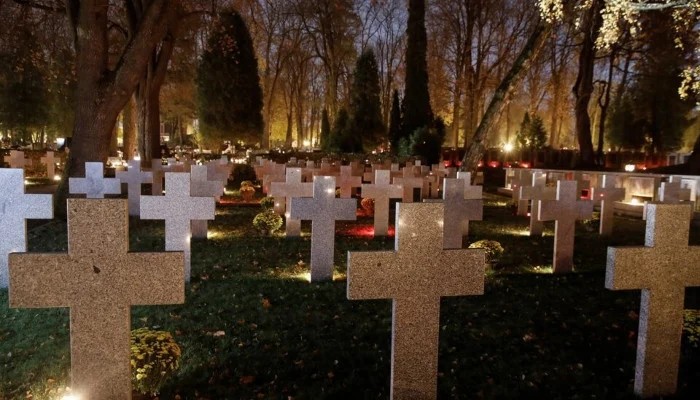
A meeting of the parliamentary Minority Caucus on Friday reviewed issues relating to the availability, management and capacity of cemeteries/graveyards for Christian and other minority communities in Islamabad and Rawalpindi. The committee, headed by Senator Danesh Kumar, also examined alleged encroachment, allotment and occupation of Christian graveyard land of the Roman Catholic Christian Cooperative Housing Society, Humak. The committee was briefed on the cemeteries and burial sites available for Christian and other minority communities in Islamabad, including their locations, areas, present status and burial capacity.
The committee was informed that the Directorate of Municipal Administration (DMA), Metropolitan Corporation Islamabad (MCI), is responsible for the management and maintenance of designated graveyards/cemeteries within Islamabad under the relevant provisions of the Islamabad Local Government Act, 2015. It was told that the Christian Graveyard in Sector H-9/3 (Old) was set up in 1981 over an area of 3.13 acres, where approximately 2,000 graves had been filled and no further space was available.
Approximately 6,000 graves in Christian graveyard in Sector H-9/2 (Old), set up in December 2000 over an area of 6 acres, had been filled, with no further space available. The committee was further informed about another Christian graveyard established in September 2017, having an area of 3.90 acres, with a capacity of approximately 3,000 graves. Regarding the Christian graveyard in Sector H-8/1, the committee was told that it was established on July 16, 2024, over an area of 9.58 acres, with a total capacity of approximately 9,000 graves.
So far, around 1,120 graves had been filled, while approximately 8,500 graves could be accommodated in the remaining 8.58 acres. The committee was also told that the Qadiani graveyard in Sector H-9/2 covers 3.42 acres and is managed by the community itself. The Bahai's graveyard in Sector H-9/2 covers 1.7 acres and is also managed by the community.
The Ismaili's graveyard in Sector H-8/3 covers 2.45 acres and is managed by the community. It was further informed that Shamsan Ghat, Sector H-9/2, covers 0.48 acres. So far, one cremation had been performed at the site in October 2012.
The committee chairman sought further details regarding the remaining burial capacity of minority graveyards, including those which had been closed or had no further available space. He also inquired about the availability of boundary walls and other facilities at the graveyards. The officials informed the committee that, vide notification dated February 25, 2019, the Punjab governor delegated the powers of the Registrar Cooperative Societies under the Cooperative Societies Act, 1925, to designated field officers.
The Circle Registrar, Rawalpindi, is the concerned Registrar of the Roman Catholic Christian Cooperative Housing Society Ltd., Rawalpindi. Regarding the Christian graveyard, the officials informed the committee that 10 kanals had been earmarked for the Christian graveyard in the society's working layout plan. According to the revenue record, the land was classified as Shamlat-e-Deh, with the society recorded as Kashtkar vide Intiqal No.
2998 dated September 24, 1995. The committee was told that out of the 10 kanals, 2.5 kanals were fully utilised as a graveyard, 6.25 kanals remained vacant, while 1.25 kanals had been carved into three plots of 10 marlas, 10 marlas and 5 marlas by the previous managing committee and allotted during 2006-08. The committee chairman directed the authorities concerned to hear all parties having reservations or grievances and submit a comprehensive report to the committee.
He emphasised that the relevant departments, being regulatory authorities, should ensure effective oversight and timely resolution of such matters. The committee was informed that the managing committee would submit the complete relevant record to the authorities concerned within two weeks. The officials assured the committee that responsibility would be fixed and appropriate action would be taken against officials found involved in any irregularity.
The chairman further emphasised the need for appropriate institutional mechanisms for the timely resolution of issues faced by minority communities and directed the authorities concerned to ensure that their grievances were addressed through the relevant legal and administrative mechanisms.