
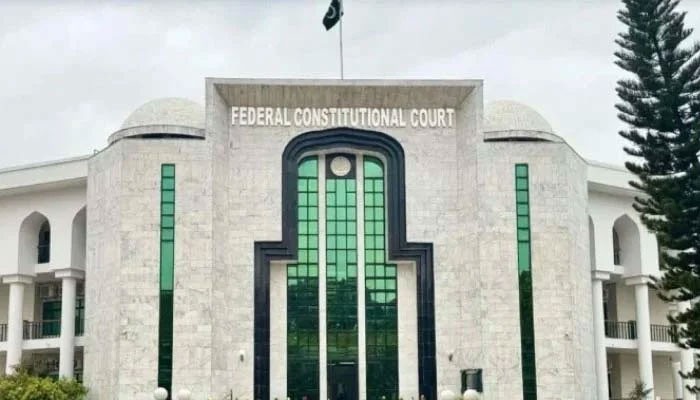
The Federal Constitutional Court (FCC) has held that the presence of a sexual element is essential for harassment to be actionable under the Protection Against Harassment of Women at the Workplace Act, 2010, and that merely undesirable, inappropriate or harmful conduct does not constitute sexual harassment under the law. The court set aside the Islamabad High Court's judgment and restored the order passed by the President in a harassment matter.
A three-member SC bench comprising Chief Justice Aminuddin Khan, Justice Ali Baqar Najafi and Justice Syed Arshad Hussain Shah allowed petitions, filed by two bank officials in a case concerning a female bank employee. In its detailed written judgment, the court held that the Protection Against Harassment of Women at the Workplace Act, 2010 could not be applied to every form of inappropriate conduct or complaint.
It said the presence of a sexual element was necessary for harassment to be actionable under the law. The judgment said conduct that was undesirable or harmful but lacked a sexual element would not be entertainable by the Federal Ombudsman under the Act. However, the organisation concerned could take disciplinary action in such matters under its own service rules.
The court clarified that the basic purpose of the law was to protect women and men at the workplace from sexual harassment and, therefore, it could not be applied to every complaint of a general nature. The FCC also held that the President was empowered under the law to hear a representation against a decision of the Federal Ombudsman. It said the High Court, while exercising its constitutional jurisdiction, could interfere with an ombudsman's decision only where abuse of authority, violation of law or breach of the principles of natural justice was established.
The Federal Ombudsman had taken action against the two officials and awarded them the penalty of dismissal from service. The president, while accepting their representations, modified the penalty of dismissal and directed that they instead be reprimanded. The IHC had set aside the President's order and restored the Federal Ombudsman's decision.
The two officials subsequently approached the Federal Constitutional Court against the High Court judgment. The FCC allowed their petitions, set aside the Islamabad High Court's judgment dated December 31, 2024, and restored the order passed by the President.