
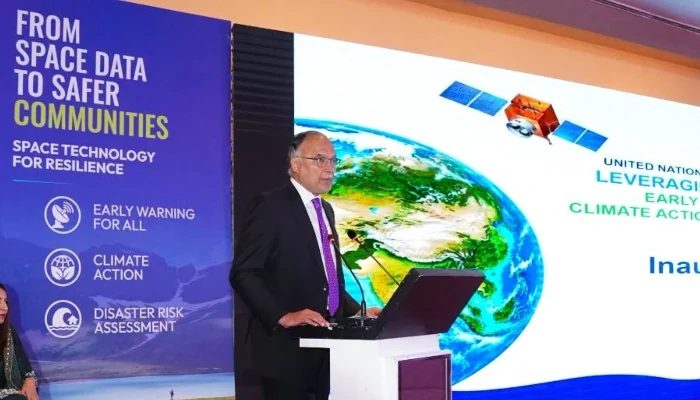
Federal Minister for Planning, Development and Special Initiatives Ahsan Iqbal on Tuesday underscored the urgent need for the effective and timely use of space technology to protect vulnerable communities from the devastating impacts of climate change and natural disasters. Addressing the inaugural session of an international conference held in collaboration with the United Nations Office for Outer Space Affairs (UNOOSA) in Islamabad, the minister said that satellite-based information and early warning systems could significantly reduce loss of life and economic damage caused by natural disasters, including cyclones, floods and glacial melting.
He highlighted the disproportionate burden Pakistan faces from climate change despite contributing less than one per cent to global greenhouse gas emissions. Referring to the devastating floods of 2022 and 2024, the minister said Pakistan had suffered enormous economic losses, exceeding $30 billion.
He complained that despite the scale of the devastation, international partners and financial institutions had failed to provide adequate new grant financing for reconstruction and recovery, instead proposing the repurposing of previously approved loans for education and health. The minister termed this approach inconsistent with the principles of climate justice and called for urgent reforms in the international financial architecture established after the Second World War.
Emphasizing that developing countries disproportionately affected by climate-related disasters must receive fair and accessible financial assistance, he stressed that vulnerable nations should not be pushed further into debt to address a crisis they have contributed little to creating. Highlighting Pakistan's progress in space technology, he said the country had successfully launched five satellites over the past 18 months, reflecting its growing commitment to strengthening national capabilities in space science and technology.
The minister also announced that Pakistan was preparing to send its first astronaut into space in the near future, marking a significant milestone in the nation's scientific and technological advancements. He emphasised that space-based information must become an integral part of national development planning, particularly in the design and construction of critical infrastructure, including bridges, roads and hospitals.
Incorporating satellite data and risk assessments into development projects, he concluded, would help improve resilience, reduce vulnerabilities and ensure more sustainable investments across all sectors of the economy.