
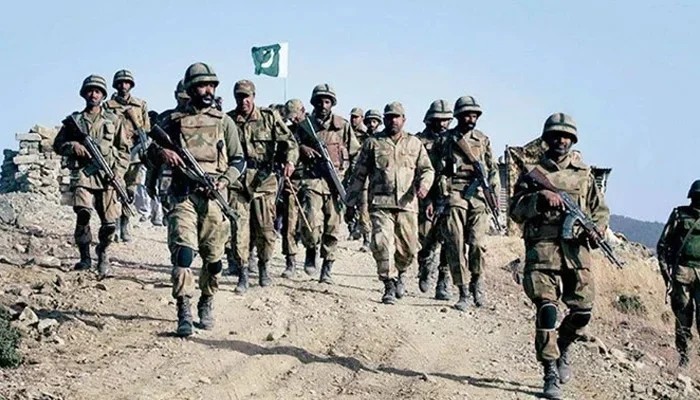
Every September 6, Pakistan pauses to honour the soldiers who stand between it and its enemies. Judged by its own record, 2026 will be remembered as one of the most consequential years in the Pakistan Army's modern history, a year in which battlefield resolve, naval foresight, and battlefield tested diplomacy combined to reshape the country's standing at home and abroad. Start with the counterterrorism campaign, the daily grind that rarely makes headlines but defines the institution's character.
The military's own accounting puts the number of intelligence based operations conducted in 2026 above 40,000, nearly 200 a day, with Balochistan alone responsible for more than 31,000 and Khyber Pakhtunkhwa another 7,000 plus. More than 2,000 confirmed terrorists were neutralised, the highest tempo the army has ever sustained. That is not a force struggling to hold ground; it is a force imposing its will on some of the most difficult terrain on earth, against threats Islamabad has repeatedly said are funded and sheltered from across its borders.
Operation Shaban, launched on July 5 this year, after militants struck Hanna Urak and the security post guarding the Mangi Dam, showed the same resolve at province wide scale. For the first time, the Army, Frontier Corps and Balochistan Police ran simultaneous fronts, against the Tehreek-e-Taliban Pakistan (TTP) near Ziarat in the north and the BLA around Lasbela and Khuzdar in the south. Losses inflicted on terrorists passed 100 within a fortnight.
When the BLA answered with an ambush near Mastung that martyred Pakistani soldiers, the state did not blink: the Prime Minister travelled to Quetta in person and pledged the operation would run its full course, a rare and unambiguous alignment of political and military will. The army's reach extended well past Balochistan's mountains. In February, Pakistan Air Force jets struck Tehreek-e-Taliban Pakistan (TTP) and ISKP hideouts inside Afghanistan's Nangarhar and Paktika provinces in retaliation for a wave of suicide bombings, a clear signal that sanctuary across a border buys no immunity.
At sea, the Navy's Operation Muhafiz ul Bahr, launched in March early this year, guarded merchant shipping across the Arabian Sea, the Gulf and the Red Sea as the Iran war rattled regional trade routes, protecting the country's energy lifeline before a crisis could reach its shores. Then came May 2025's defining test. After India's Operation Sindoor struck Pakistani and Pakistan administered territory, the Armed Forces answered with Operation Bunyanum Marsoos.
Over four days, Pakistan's integrated air defence network held, its pilots downed multiple Indian aircraft including Rafales, and its forces struck Indian military installations. Army Chief Asim Munir's subsequent elevation to Field Marshal's position, only the second such honour in the country's history, was recognition of the campaign he had overseen. What followed was a diplomatic harvest few expected.
Munir became the first serving Pakistani army chief hosted alone at the White House, an audience President Trump extended personally and repeated months later. That capital was quickly put to use: when the US Israel war on Iran threatened to spiral after the February 28 killing of Iran's Supreme Leader, it was Pakistan, not a traditional Gulf power, that Washington and Tehran turned to. Islamabad hosted the resulting peace talks in April this year, with Pakistan's interior minister personally assuring the US ambassador of comprehensive security for the 300 strong American delegation led by Vice President JD Vance.
Weeks of shuttle diplomacy followed, and by June, Pakistan had mediated a US-Iran agreement after more than 100 days of war, with the Prime Minister publicly crediting the army chief's personal efforts in securing the breakthrough. Field Marshal Asim Munir travelled to Tehran twice to keep the process alive, soldier and diplomat statecraft rarely seen from a serving chief of army staff, and one that arguably did as much to prevent a wider regional war as any single battlefield victory this year.
The dividends kept compounding: a mutual defence pact with Saudi Arabia extending Pakistan's security umbrella across the Gulf, renewed momentum on a US trade deal, and global defence circles studying the performance of Pakistani hardware with the attention usually reserved for first tier military powers. In a single year, the army moved from managing an insurgency at home to setting the terms of a regional war's end abroad, from Ziarat and Lasbela to Islamabad's negotiating table.
None of this came free. Soldiers, airmen and police officers paid for every one of these outcomes, often with their lives. That is what Defence Day exists to remember.