
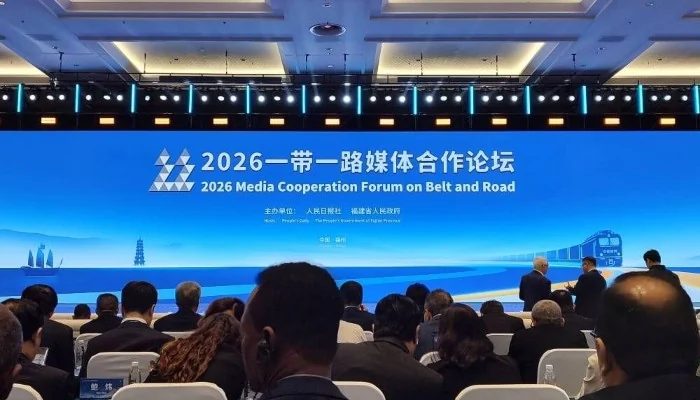
The 2026 Belt and Road Media Cooperation Forum opened on Tuesday in Fuzhou, Fujian Province, bringing together more than 200 delegates from 182 media outlets and institutions across 100 countries, as well as representatives of international and regional organisations. Participants stated that high-quality Belt and Road cooperation has evolved into a widely recognised global public good and a major platform for international economic cooperation.
Delegates stressed the need for media organisations worldwide to collaborate in sharing compelling narratives regarding the Silk Road. They emphasised that the media should promote policy coordination and people-to-people exchanges, while fostering a positive public opinion environment.
The forum, co-hosted by the People's Daily and the People's Government of Fujian Province, is being held under the theme "Pursuing Common Understandings and Shared Aspirations along the Belt and Road." The programme includes an opening ceremony, an exhibition showcasing the achievements of Belt and Road cooperation, and the fourth Council Meeting of the Belt and Road News Network.
It also features three sub-forums: the 2026 Belt and Road Regional Cooperation Forum, the 12th ASEAN-China-Japan-Republic of Korea Media Cooperation Seminar, and the 2026 Silk Road Civilization Development Forum. The event serves as a critical juncture for media leaders to discuss the future of digital connectivity and the role of journalism in bridging cultural divides.
By leveraging modern communication tools, participants aim to enhance the visibility of infrastructure projects that have transformed local economies. Experts at the forum highlighted that the Belt and Road Initiative (BRI) has provided developing nations with essential infrastructure, which in turn has fostered regional stability.
Media outlets were encouraged to report on these developments with accuracy and depth to counter misinformation. The People's Daily, as a primary organiser, noted that the forum has grown significantly since its inception, reflecting the increasing interest of global media in the initiative.
The discussions are expected to yield a joint declaration on media ethics and cooperation. Furthermore, the exhibition segment provides a visual journey through the various projects completed under the initiative, ranging from railways and ports to renewable energy plants.
These visual aids are intended to help journalists better understand the tangible impacts of the BRI. As the forum progresses, delegates will engage in roundtable discussions to address challenges such as the digital divide and the impact of artificial intelligence on media production.
These sessions are designed to foster long-term partnerships between media houses. The closing session will focus on the adoption of a roadmap for future media collaboration, ensuring that the momentum generated in Fuzhou continues to influence international discourse throughout the coming year.