
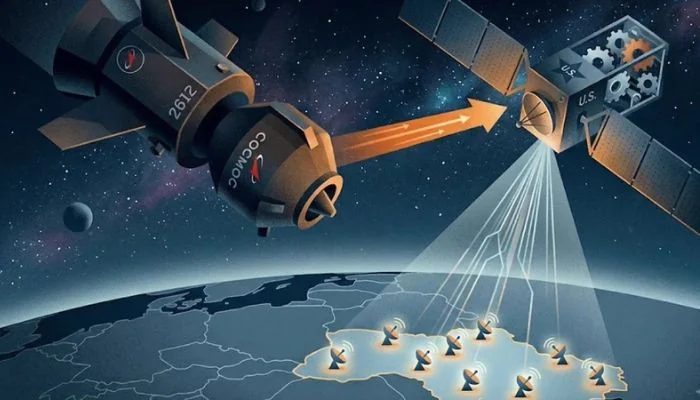
Russia may have rehearsed an attack on a Western satellite providing intelligence to Ukraine after one of its military spacecraft moved dangerously close to the satellite last month, raising concerns that Moscow could be preparing to extend the war into space. The Russian spacecraft, Cosmos 2612, approached the X36 satellite operated by Finnish company ICEYE in mid-October, coming within one kilometre of it.
Some experts believe the distance was reduced to just a few hundred metres. The incident has become more alarming as two other Russian military satellites are now moving towards the orbital path of another ICEYE spacecraft, X37, according to space analysts and US tracking company COMSPOC.
The X36 satellite provides radar imagery to Western governments and militaries, including Ukraine, helping them monitor activities on the ground. Cosmos 2612 was among six Russian military satellites launched in April.
Four of them moved close to X36 in May, prompting ICEYE to reposition its spacecraft. The latest manoeuvres have also caught Washington's attention.
US Under Secretary of State Thomas DiNanno accused Russia of deliberately bringing its satellite dangerously close to a commercial spacecraft, describing the behaviour as consistent with operations involving weapons in orbit. However, Germany's space commander, Major General Michael Traut, cautioned that the movements alone could not establish whether Russia was preparing an attack.
Russia has previously warned that Western commercial satellites assisting Ukraine could become legitimate military targets. Moscow has denied Western accusations about its recent space activities, while its defence ministry did not respond to requests for comment.
The international community remains on high alert as the militarization of space becomes a growing reality. Analysts suggest that the proximity of these satellites is not merely coincidental but a calculated move to test the defensive capabilities of Western orbital assets.
As the conflict in Ukraine continues, the domain of space is increasingly viewed as a critical theatre where electronic warfare and surveillance dominance are being contested. Space security experts emphasize that such close-approach manoeuvres, often referred to as 'rendezvous and proximity operations,' are technically complex and carry significant risks of collision.
Any accidental or intentional collision could create a massive debris field, threatening other satellites in the same orbit. The US and its allies are currently reviewing their space security protocols to better protect commercial assets that have become vital for intelligence gathering.
While diplomatic channels remain open, the lack of clear communication from the Kremlin regarding these specific orbital manoeuvres continues to fuel tensions between Moscow and the West. As the situation develops, the global space industry is watching closely to see if international norms regarding space conduct will be upheld or if the current trend of aggressive posturing will lead to a new era of orbital confrontation.