
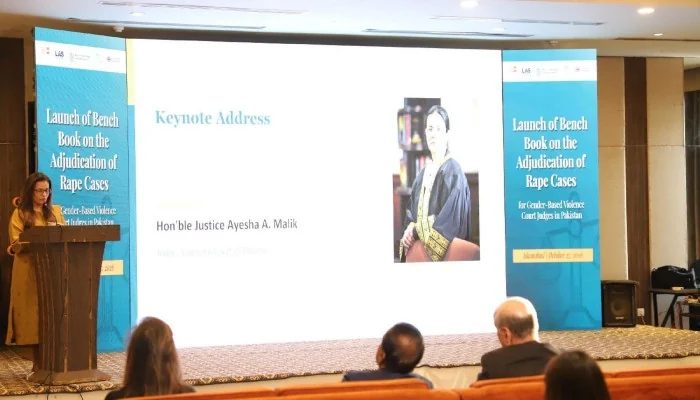
The Ministry of Human Rights (MoHR), in collaboration with the Legal Aid Society (LAS) and the United Nations Population Fund (UNFPA), has launched the Bench Book on the Adjudication of Rape Cases for judges of gender-based violence courts in Islamabad. Launched alongside a national study on low conviction rates in gender-based violence cases, the Bench Book provides a practical reference to support fair trials and judicial decisions grounded in law and evidence.
The two publications address connected challenges across the criminal justice process, examining where cases falter from the first report through investigation, medico-legal examination, prosecution, and trial. The Bench Book brings together applicable law and judicial guidance in ten chapters following the sequence of a trial, supporting judges in assessing the evidence placed before them.
Opening the event, Abdul Khalique Shaikh, Secretary, Ministry of Human Rights, affirmed the ministry's custodianship of both documents. "The honest position is that the word on paper and the practice on the ground have not yet converged," he said, calling for greater attention to how legal protections are delivered in practice.
Barrister Haya Emaan Zahid, Chief Executive Officer of LAS, illustrated the survivor's journey, highlighting the pressures survivors face and the need to assess delayed reporting, gaps in medical evidence, and family power dynamics in their proper context. Luay Shabaneh, Country Representative, UNFPA Pakistan, linked fair adjudication to Pakistan's international human rights commitments.
"A judgment that is correctly reasoned protects everybody in and outside the courtroom," he said. Mary Kate Thomson, Senior Governance Adviser at the British High Commission, emphasised that public trust is shaped by how everyday cases are handled, which in turn influences whether survivors come forward.
Senator Ayesha Raza Farooq, Chairperson of the Special Committee on the Anti-Rape Act, addressed the practical application of the Anti-Rape (Investigation and Trial) Act, 2021. "The Bench Book takes what Parliament enacted, together with what the superior courts have held, and places it within reach of the judge who has to apply it," she said.
Rabeea Hadi, Director General Child Protection ICT, MoHR, presented the study on low conviction rates, prepared by the ministry alongside the Senate Functional Committee on Human Rights. Advocate Maliha Zia, Director Gender, Inclusion & Development at LAS, presented the Bench Book's structure and its intended use during court proceedings.