
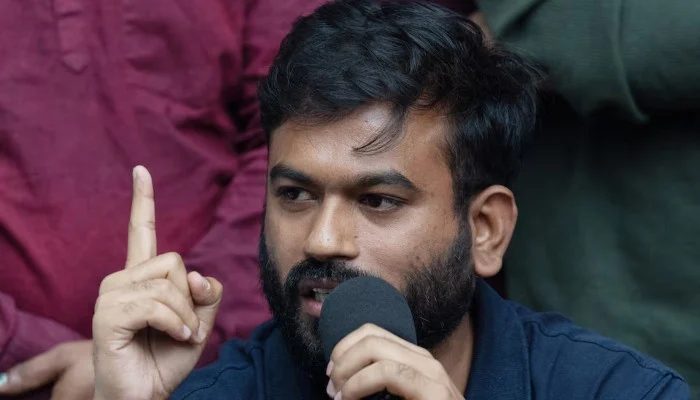
NEW DELHI: The leader of India's "cockroach" youth movement was released by a court on Saturday, a day after being detained for attempting to lead a protest in New Delhi demanding the resignation of the country's election chief. Abhijeet Dipke, founder of the Cockroach Janta Party (CJP), rose to prominence this year when a weeks-long sit-in contributed to the resignation of India's education minister.
Ratna Singh, head of legal affairs for the CJP, stated that Dipke was released after agreeing to certain conditions, though she provided no further details. Dipke's youth-led group, alongside opposition parties and student organizations, has held near-daily protests this month demanding the resignation of Chief Election Commissioner Gyanesh Kumar over a revision of voter lists, which critics claim favors Prime Minister Narendra Modi's Bharatiya Janata Party (BJP).
More than 130 million voters were removed during the revision. The Election Commission has denied bias, stating that wrongly deleted voters can re-enroll.
The BJP has accused its rivals of attempting to undermine democracy by questioning legitimate electoral processes. Student activist Neha Bora, a prominent face of the protests who was detained on Friday while attempting to reach central Delhi with supporters, was also released on Saturday.
"Please, spare the people of India. Impeach Gyanesh Kumar and halt the Special Intensive Revision (SIR), so that ordinary citizens can breathe a sigh of relief and have their voting rights ensured," Bora told the ANI news agency following her release.
The movement, mobilized by youth and joined by various opposition parties, has emerged as one of the most significant political challenges faced by Modi and the BJP during his 12 years in power. Observers note that the "cockroach" moniker, initially used as a derogatory term by political opponents, has been reclaimed by the activists as a symbol of resilience and persistence against the establishment.
The ongoing protests have paralyzed parts of the capital, leading to heavy security deployments and frequent clashes between police and demonstrators. The government maintains that the electoral roll revision is a routine administrative exercise aimed at cleaning up the database, but the opposition remains skeptical.
As the political temperature rises, international observers are closely monitoring the situation, particularly regarding the freedom of assembly and the rights of protesters. The release of Dipke and Bora is seen as a temporary reprieve, but both leaders have vowed to continue their agitation until their demands are met.
The CJP has announced plans for a nationwide campaign to raise awareness about the alleged irregularities in the voter lists. With the next general election cycle approaching, the pressure on the Election Commission to ensure transparency and fairness is expected to intensify significantly.
Analysts suggest that the success of this movement will depend on its ability to maintain momentum and broaden its base beyond urban student populations. For now, the streets of New Delhi remain a focal point of this unfolding political drama.