
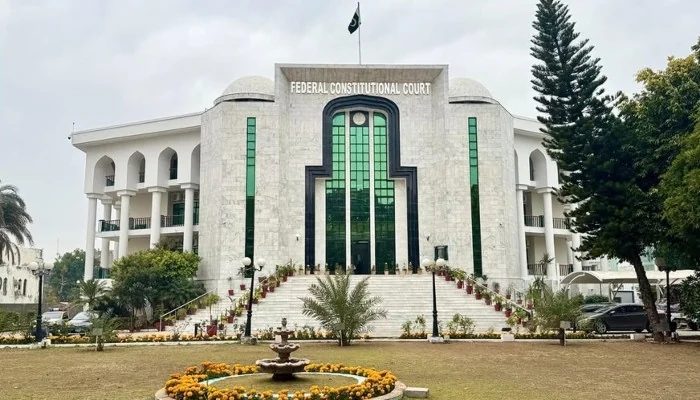
The Federal Constitutional Court (FCC) has ruled that concluded judicial decisions cannot be reopened through repeated litigation. A two-member FCC bench, comprising Justice Rozi Khan Barrech and Justice Syed Arshad Hussain Shah, announced the judgment in a case concerning the construction of a school on land claimed to be owned by a woman named Anwari Bibi.
Petitioner Anwari, daughter of Dilawar Shah, through her legal heirs, had filed an appeal against the Lahore High Court judgment delivered on April 27, 2016. The dispute related to the ownership of land allocated for the construction of a girls' school in Bhakkar.
The heirs of Anwari Bibi maintained that the girls' school had been constructed on land owned by their family. The petitioners challenged previous decisions concerning the division of the land and the construction of the school.
The FCC, after hearing the case, dismissed the appeal filed by the heirs of Anwari Bibi against the LHC verdict, holding that there was no illegality, infirmity, misreading, or non-reading in the findings of the lower fora warranting interference. The nine-page judgment, authored by Justice Arshad Hussain Shah, held that in the present case, the allocation and reallocation of the land had already been examined in an earlier round of litigation, which ultimately reached the Supreme Court, and the determination of the consolidation authorities remained undisturbed.
"The controversy could not, therefore, be reopened merely by disputing the identification of the land or the Khasra numbers assigned to it, in the absence of an independent and legally sustainable ground for interference," the judgment states. The court noted that while dealing with the question of allocation/reallocation of fields, the Supreme Court observed: "We find that the question of allocation/reallocation of the fields in a revenue state is primarily the function of the Consolidation Authorities."
The court ruled that repeatedly bringing the same dispute before courts is contrary to the intent of the law, adding that final judicial decisions cannot be challenged repeatedly and without solid legal backing. The court observed that giving finality to court judgments is essential for the justice system and the supremacy of law.
"Once a judgment becomes final, it cannot be reopened unless fraud, an error, or lack of jurisdiction is established," the judgment says. The court concluded that the determinations made by the consolidation authorities, upon attaining finality in accordance with law, are not ordinarily amenable to interference in constitutional jurisdiction.