
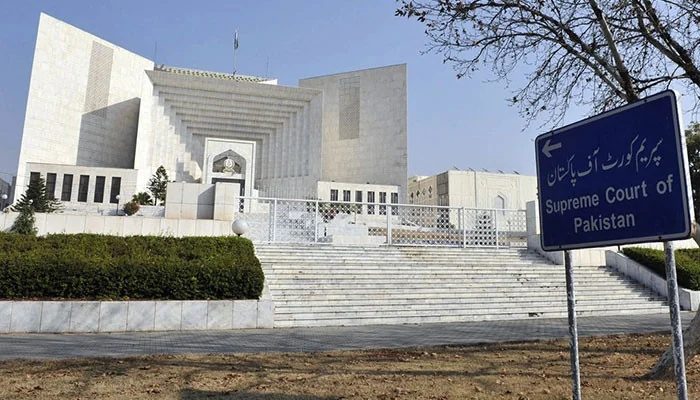
The Supreme Court (SC) has ruled that no court has the right to decide any case which is beyond the purview of its jurisdiction. The court held that the Punjab Service Tribunal has no powers of review under the PST Act, adding that the power of review must be the creature of statute.
- The Supreme Court ruled that the Punjab Service Tribunal lacks the statutory authority to conduct reviews of its own orders.
- A two-member bench headed by Justice Muhammad Ali Mazhar and Justice Musarat Hilali set aside the tribunal's order dated May 14, 2024.
- The court affirmed that both the right of appeal and the right of review must be explicitly provided by statute to be legally valid.
Supreme Court and Punjab Service Tribunal
A two-member bench of the apex court, headed by Justice Muhammad Ali Mazhar and comprising Justice Musarat Hilali, announced the judgment in a service matter titled Inspector General of Police, Punjab, Lahore & others versus Alamdar Hussain. The petitioners, IGP Punjab and others, had filed an appeal against the order dated May 14, 2024, passed by the Punjab Service Tribunal, Lahore.
The court, after hearing the case at length, allowed the appeal and set aside the impugned order passed by the learned Punjab Services Tribunal. "As underscored previously, the PST is vested with powers of civil court for deciding appeal only without any separate powers for reviewing its own order; therefore, in this same context, it is to be tracked closely as to whether a review application constitutes a continuation of appellate jurisdiction," says an eleven-page judgment, authored by Justice Muhammad Ali Mazhar.
Statutory Jurisdiction and Legal Limitations
The court ruled that the right of appeal and right of review both must be the creation of statute; therefore, a court or tribunal cannot assume review jurisdiction unless it is provided explicitly in the governing law.
"Any proceedings conducted or any judgment or order beyond the scope of powers conferred by the law to the Tribunal shall be considered ultra vires and coram non judice, except the clerical, arithmetical, or typographical mistakes as provided under Rule 22 of the Rules 1975 in the present case," says the judgment.