
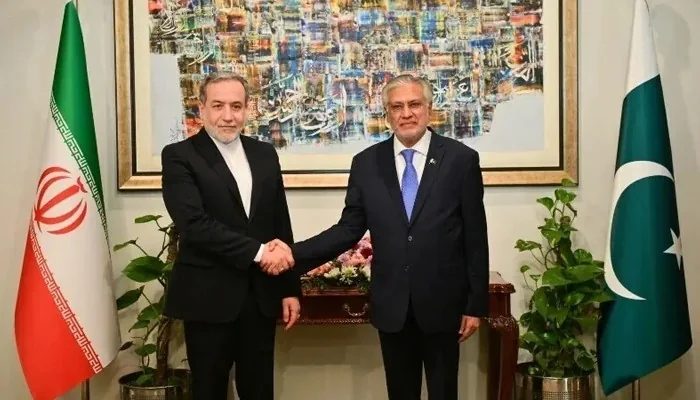
ISLAMABAD/DUBAI/TEHRAN: Deputy Prime Minister and Foreign Minister, Senator Ishaq Dar spoke with Iranian Foreign Minister Abbas Araghchi on Thursday, exchanging views on regional developments. A news release from the Deputy Prime Minister's Office stated that the two discussed the evolving regional situation.
Dar underscored the importance of sustained dialogue and diplomacy in addressing outstanding issues, emphasizing that all parties must remain constructively engaged. He reaffirmed that active diplomatic efforts are essential for lasting peace and stability.
Separately, Deputy Prime Minister Dar held a telephone conversation with Omani Foreign Minister Sayyid Badr bin Hamad bin Hamood Al Busaidi. Meanwhile, Dar announced that the United Nations Security Council (UN Security Council) adopted a Presidential Statement (PRST) initiated by Pakistan on "The Role of Diplomacy during Active Hostilities."
He stated that Pakistan remains committed to advancing diplomacy through "purposeful and concrete action." Additionally, Dar met with UK Minister of State for Security, Dan Jarvis, to review bilateral relations and discuss mutual security concerns. In Moscow, Iran's Security Chief Mohsen Rezaei delivered a message from Supreme Leader Ali Khamenei to President Vladimir Putin.
Rezaei noted that Putin stressed the need for regional security mechanisms and the "inadmissibility of external interference" in the Middle East. Iranian Foreign Minister Araghchi also held separate calls with his Saudi, Qatari, UAE, Omani, Turkish, Jordanian, and Kuwaiti counterparts to discuss diplomatic efforts for regional stability.
These high-level contacts reflect the urgency felt by regional capitals regarding current tensions. Local media reported that five oil tankers and a tugboat caught fire in the Strait of Hormuz.
Following these events, South Korea's defence ministry announced the deployment of maritime patrol aircraft to the region to monitor the situation and ensure the safety of commercial shipping. Furthermore, the Turkish Defence Ministry reported that one soldier was killed on 31 October due to cross-border fire from Iran.
The ministry stated that it is investigating the incident while maintaining a defensive posture along the border. Simultaneously, the Saudi-led coalition intercepted a ballistic missile fired by Houthi rebels.
The coalition spokesperson confirmed that the missile was aimed at civilian infrastructure, marking a significant escalation in the ongoing conflict. As diplomatic channels remain open, the international community continues to monitor the Strait of Hormuz closely.
Analysts suggest that the combination of high-level diplomatic engagement and military incidents underscores the volatility of the current regional security environment.