
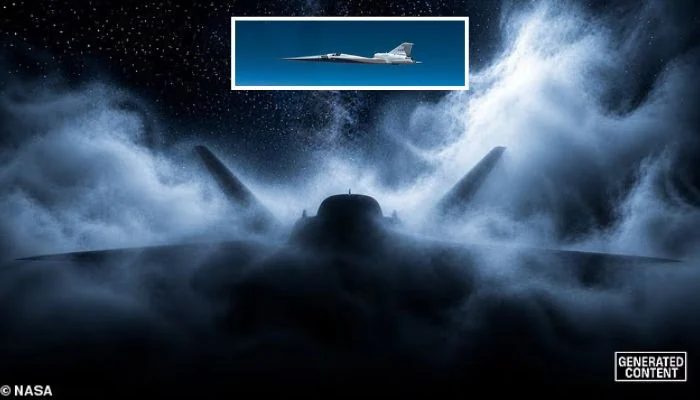
NASA has unveiled a new experimental aircraft designed to perform manoeuvres never before attempted by a piloted plane, marking a significant milestone in modern aeronautical research. However, the American space agency is keeping much of its advanced design under wraps as development continues at a rapid pace behind closed doors.
Named the X-70 Fractal, the revolutionary aircraft was officially announced on Wednesday, November 4, during the high-profile UP.Summit held at NASA's Kennedy Space Center in the state of Florida. During the grand unveiling, senior agency officials provided initial specifications regarding the craft's projected performance capabilities in varied atmospheric conditions.
The agency stated that the plane will be fully capable of cruising at around 575mph and safely reaching a cruising altitude of 45,000 feet. This operating ceiling places it significantly higher than the altitudes utilized by most commercial passenger aircraft currently operating in global airspace.
Unlike conventional commercial or military aircraft, the newly minted X-70 will feature an advanced, adaptable flight-control system. Engineers will be able to quickly modify this software and hardware architecture to test innovative ways of controlling a plane dynamically in mid-air.
This flexibility is expected to drastically cut down the time required for iterative aerodynamic testing during the various phases of the flight test campaign. Furthermore, the cutting-edge craft will be engineered to carry up to 2,000 pounds, equivalent to roughly 907 kilograms, of specialized experimental equipment.
Researchers and payload specialists can easily replace these scientific modules without requiring engineers to build a completely new aircraft structure from scratch. Such modularity is anticipated to lower research costs and accelerate the pace of future flight testing initiatives.
Despite the excitement surrounding the announcement, NASA has released only a single artificial intelligence-generated conceptual image so far. The rendered visual shows a sleek, dark, fighter jet-like aircraft that is partly obscured and hidden by thick clouds.
This deliberate visual ambiguity has left aviation enthusiasts and defense analysts speculating about the true aerodynamic shape and radar-evading properties of the mysterious machine. So far, the agency has strictly avoided disclosing the primary manufacturer, the total development cost, or the final production design of the plane.
Industry insiders suggest that these details are being classified to protect proprietary technologies and maintain a competitive edge in aerospace engineering. Despite the secrecy, the broader scientific community has expressed immense enthusiasm for the project's potential outcomes.
NASA Administrator Jared Isaacman spoke to reporters about the strategic importance of the undertaking during the summit. Isaacman stated that the X-70 would allow researchers and test pilots to rigorously test technologies that have not previously been demonstrated in crewed flight.
He emphasized that pushing the boundaries of flight safety and efficiency remains a core mission for the agency in the modern era. The experimental aircraft is widely expected to make its maiden flight under NASA's strict oversight programme within the next two years.
Although program managers remain optimistic about this timeline, no exact calendar date for the rollout or first flight has been formally announced yet. Extensive ground tests will need to be successfully completed before the vehicle is cleared for actual runway operations.
According to current projections, the craft will possess an estimated takeoff weight of around 10,000 pounds. Additionally, engineers have calculated that its maximum flying range will comfortably exceed 1,726 miles on a single fuel load.
These operational parameters suggest that the aircraft is intended for extended data-gathering missions rather than brief hops. The X-70 proudly joins NASA's long-running and legendary experimental aircraft programme, which has a storied history of pushing the envelope of flight.
This historic lineage famously produced the Bell X-1, which was the very first piloted aircraft to successfully break the sound barrier back in 1947. Building upon this heritage, NASA is also actively testing the X-59, an innovative aircraft specifically developed to dramatically reduce the loud sonic boom noise produced during supersonic flight.