
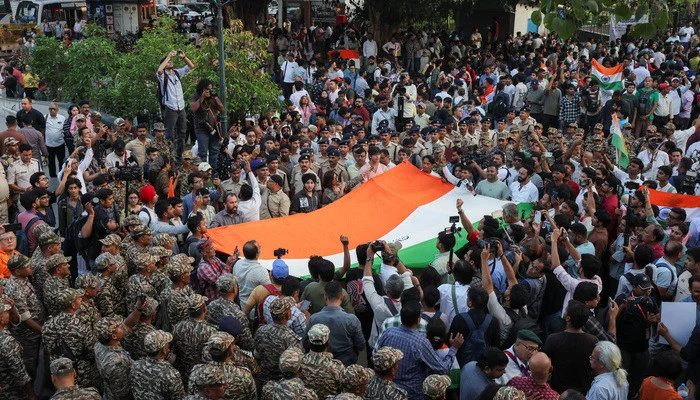
Kamta Prasad has been shuttling between government offices in Delhi trying to prove he is not dead. The 53-year-old tailor is among 130 million names removed from India's electoral rolls under a voter roll revision that has sparked mass protests and posed the biggest challenge to Prime Minister Narendra Modi's government.
The Special Intensive Revision (SIR) has led to removals for reasons ranging from "logical discrepancies" to people being recorded as dead, leaving many such as Prasad struggling to get their voting status restored. He has had to forgo his daily wage of 250 rupees that supports his family of four to scurry around the city to reverse the error.
"I panicked when I heard about it," said Prasad, who is among 4.2 million Delhi voters struck off the list, according to the draft rolls published by the poll body on 31 August. "Since then I've been going everywhere to prove that I'm alive."
The deletions have triggered a political storm, with opposition parties and youth groups staging near-daily protests in New Delhi and elsewhere. They allege Election Commission chief Gyanesh Kumar manipulated the revision to benefit Modi's Bharatiya Janata Party (BJP), a charge denied by both the commission and the BJP.
According to Rajendra Kumar, a volunteer with non-profit Jan Sarokar, about 2,000 of the roughly 9,000 voters in Prasad's block were struck off after the revision, classified as absent, shifted, deceased or registered elsewhere. The scale of the deletions has raised serious questions about the integrity of the electoral process.
Civil society organizations argue that the process was opaque and lacked adequate verification, leading to the disenfranchisement of millions of genuine voters. Political analysts suggest that such mass deletions, if not corrected, could significantly alter the outcome of upcoming elections.
The opposition claims that the targeted removal of voters in specific constituencies is a calculated move to suppress the vote bank of rival parties. The Election Commission maintains that the exercise was conducted to clean up the electoral rolls by removing duplicate entries and updating the status of those who have migrated or passed away.
However, the burden of proof has been unfairly placed on the citizens. For individuals like Prasad, the process is not just about voting rights but about their identity in the state records.
The bureaucratic hurdles, including the requirement for multiple identity documents, have made it nearly impossible for the poor and elderly to rectify these errors. As the protests continue, the government faces mounting pressure to conduct a transparent audit of the revised rolls.
The situation remains tense as thousands of citizens continue to queue outside local administrative offices, hoping to reclaim their right to participate in the democratic process.