
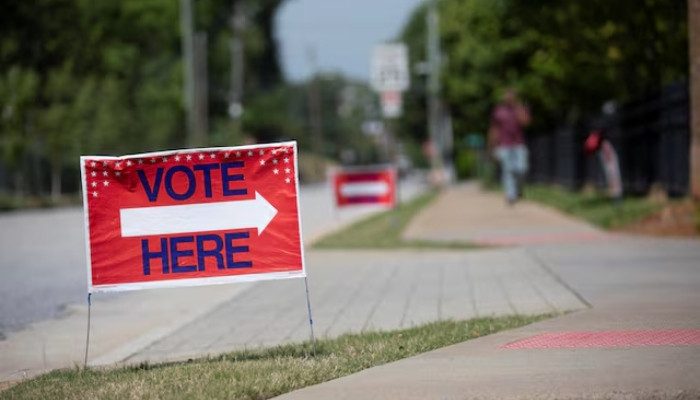
Some elections in history do more than change governments. They remind rulers intoxicated by power of their true standing, shattering the illusion of invincibility built around political power and proving that the people always have the final say.
The November 3 midterm elections in the US have done precisely that. The Democrats' resounding victory and their securing of majorities in both chambers of Congress have dealt a severe blow to the perception that US President Donald Trump is impossible to defeat.
The MAGA (Make America Great Again) movement, whose leaders and supporters had begun to believe that they alone represented the true voice of the American people, has seen Democrats make gains in states and districts considered Republican strongholds. Even some of Donald Trump's traditional supporters have turned their backs on him.
But the significance of this 'blue wave' extends far beyond the defeat of a president or his party. It is a reminder of why democracy, particularly secular democracy, is indispensable in a world where authoritarianism, religious nationalism and the politics of intolerance are rapidly gaining ground.
The most encouraging aspect of these elections is that Americans from different racial, religious, national and economic backgrounds rose above their differences to challenge a political movement whose strength lay precisely in exploiting those divisions. This is the fundamental virtue of secular democracy.
It allows people of different beliefs, cultures and identities to live together as equal citizens. Secular democracy does not demand that anyone abandon their religion or cultural identity; it simply asks them to accept the principle that no religion, race or group has a greater claim to the state than others.
Authoritarian-minded rulers, by contrast, derive their political power from precisely these divisions. They manufacture imaginary enemies, inflame religious and nationalist sentiments, and convince their supporters that their identity, culture and even their very existence are under threat.
American voters have proved that this politics can be defeated. Perhaps the most important message of these elections came from the younger generation.
Per preliminary figures from the research institute CIRCLE at Tufts University, 71 percent of voters aged 18 to 29 supported Democrats in House elections, while only 25 percent voted for Republican candidates. Young male voters, a significant proportion of whom had gravitated towards Donald Trump in the 2024 presidential election, returned to the Democrats in droves this time.
This is an extraordinary political shift. These results also challenge the widespread perception that young people, lost in social media and the digital world, have become politically disengaged.
The reality is quite the opposite. When young people feel their future is at stake, they can become the most powerful force for political change.
Of course, it would be naive to assume that everyone who voted against Donald Trump was motivated by a desire to protect democratic values. Rising inflation, economic uncertainty, government corruption and the unpopular war against Iran also played significant roles.
But that is precisely the beauty of democracy. People do not need to share the same ideology or have identical grievances to hold a government accountable.
And this resistance is not confined to the US. In Brazil, Luiz Inacio Lula da Silva's recent electoral victory over Flavio Bolsonaro serves as another major blow to aggressive right-wing populist movements globally.