
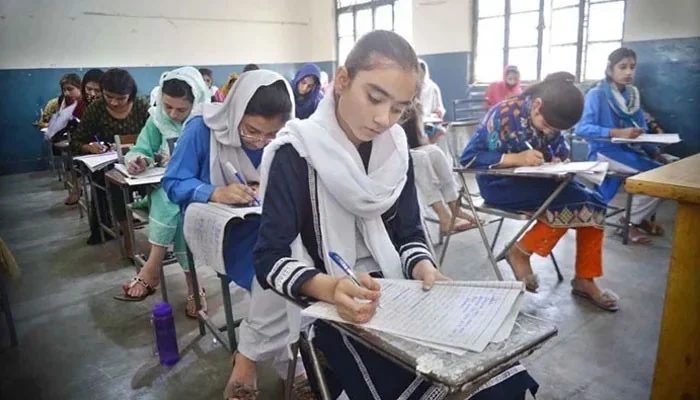
Officials revealed that 563 government schools are non-functional across Khyber Pakhtunkhwa during a special briefing held at the Governor's House in Peshawar.
- Officials revealed that 563 government schools are non-functional and 4.9 million children remain out of school.
- Adviser Aamir Abdullah stated that government schools face a shortage of 45,000 teachers.
- Twenty-six public universities in the province currently face severe financial crises.
Khyber Pakhtunkhwa education crisis
Khyber Pakhtunkhwa education officials shared grim statistics during the meeting attended by the Governor of Khyber Pakhtunkhwa, advisers, departmental secretaries, and other officials. Adviser to the Chief Minister on Education Aamir Abdullah presented figures detailing the state of the province education system, school infrastructure, financial difficulties of universities, learning standards, and proposed reforms. The province operates 34,848 government schools with approximately 5.96 million students enrolled and around 187,000 teachers. The system suffers from a shortage of approximately 45,000 teachers, maintaining an average of one teacher for every 41 students.
As many as 11,617 schools operate with only one or two teachers, while 563 government schools remain non-functional. Explaining the reasons behind school closures, the education adviser noted that 264 schools had no teachers, 107 faced issues relating to the teacher-student ratio, 76 closed due to law and order problems, 51 had no student enrolment, 35 lacked teaching staff, and 17 faced issues stemming from student absenteeism. Furthermore, the dropout rate at the middle and high school levels stands at 64 percent, and nearly 4.9 million children remain out of school. Approximately four million children are enrolled in 14,546 private schools across the province, bringing combined enrolment in public and private institutions to around 9.96 million students.
Infrastructure and learning standards
Regarding school buildings and facilities, officials stated that 4,260 schools lack essential amenities, including adequate classrooms and basic infrastructure. Additionally, 17,353 schools require reconstruction, while 18,476 need repairs. A total of 131 development projects were proposed to address these needs at an estimated cost of Rs271 billion, with completion expected to take nine years. Some schools affected by the 2005 earthquake remain unbuilt, and rehabilitation projects for flood-damaged schools are incomplete. Construction of Mardan Cadet College, which began in 2013-14, remains unfinished, and a second cadet college project launched in Lakki Marwat in 2016 also stays incomplete.
The overall education budget was reported at Rs397.90 billion, with current expenditure accounting for 79 percent and the development component at 21.9 percent. However, Adviser Aamir Abdullah said available funding was insufficient, noting that some areas requiring an allocation of Rs400 million received only Rs70 million. Learning standards remain alarmingly low, with 83 percent of students in several districts unable to read a single sentence in English, 82 percent unable to read a paragraph in Urdu, and 60 percent unable to solve basic addition and subtraction problems. Officials added that 1,700 IT laboratories were established, but 325 of them are non-functional, meaning roughly 19 percent of the laboratories do not operate.
University crises and reforms
The briefing detailed the financial and academic condition of public universities in Khyber Pakhtunkhwa, revealing that 26 of the province 34 public universities face financial crises. Abdullah noted that Swat University of Applied Sciences has only 269 students, and Swat Agriculture University has an enrolment of 636 students. To address these issues, the provincial government announced several reform initiatives. Authorities will establish seven Danish Schools in the province and upgrade the IT Park in Dera Ismail Khan. Additionally, 6,000 children will receive IT training, while 300 children will receive training before being sent abroad. Other proposed initiatives include shifting 424 educational institutions to solar energy, establishing 15 model schools, and providing 500 internships to young people.