
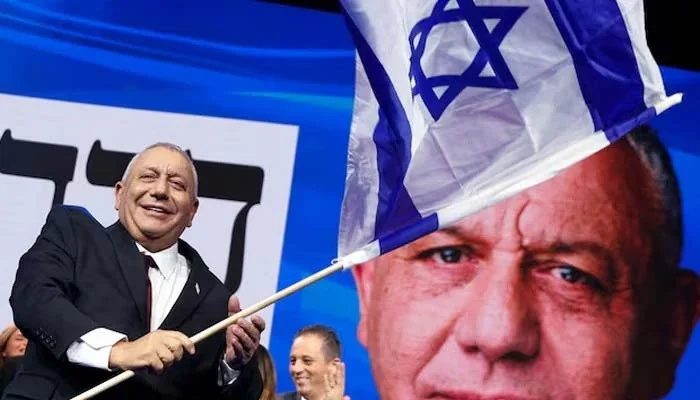
JERUSALEM: Israel's former military chief Gadi Eisenkot started the tough task Sunday of forming a government, reaching out to Benjamin Netanyahu's allies as he warned the prime minister had brought the country to a historic crisis. Eisenkot, 66, a political novice who has vowed to bridge Israel's deep polarisation under Netanyahu, formally received a mandate from President Isaac Herzog, giving him 28 days to form a government despite his bloc lacking a clear majority.
"We are in a state of emergency, approaching a point of no return for the State of Israel," Eisenkot said at a ceremony at the presidential office. "We must form a national emergency government.
This will require creative and unconventional political steps." "We are in the midst of a devastating diplomatic crisis. Even our closest friends and strategic allies are saying their relationship with Israel must be reassessed," Eisenkot said.
Eisenkot appealed to Netanyahu's Likud Party as well as the far-right party of Finance Minister Bezalel Smotrich to join - but only with himself as prime minister. "My door is open and my hand is extended, wholeheartedly and willingly, to anyone who understands the gravity of this moment," he said.
In consultations last week with Herzog, Eisenkot received recommendations from parties accounting for 67 lawmakers, against 46 for Netanyahu. But that vote count included Israeli Arabs, whose seat haul surged to a historic high on anger over Netanyahu's government and whom several parties oppose having in government.
Avigdor Liberman, a former Netanyahu aide turned sharp critic who nonetheless shares his hawkish views, has been adamant against any alliance with Arab Israelis, who are descendants of Palestinians who stayed after Israel's creation in 1948. Taking back one of his signature campaign pledges, Liberman instead voiced an openness to an alliance with ultra-Orthodox Jews, whose almost singular priority is ensuring that they remain exempt from military service.
The exemption for the ultra-Orthodox - whose two main parties had been aligned with Netanyahu but could push Eisenkot to a majority - has been a source of growing resentment for many Israelis as reservists fight on multiple tours of duty. Liberman said Sunday he still backed conscription for all Israelis but that he had to make "difficult decisions" for the higher priority of ousting Netanyahu, who faces corruption charges that could land him in jail if he loses power.
Naftali Bennett, the second strongest opposition leader after Liberman, has also been outspoken against the ultra-Orthodox community's military exemption and has stayed quiet since Liberman's about-face. Eisenkot has appeared to suggest he is willing to start off with a minority government - relying on outside votes from Arab-Israeli parties - before bringing other lawmakers into his coalition.
Assaf Shapira, a political expert at the Israel Democracy Institute, said Eisenkot would face an exceptionally fragile government if it only had 48 lawmakers in the 120-member parliament, with extensive negotiations needed on every piece of legislation. Eisenkot has vowed to put an end to rampant violence against Palestinians by extremist West Bank settlers supported by Netanyahu's government and has warned that the incumbent premier does not have the mandate for another attack on Iran, though he has largely backed Netanyahu's war decisions.