
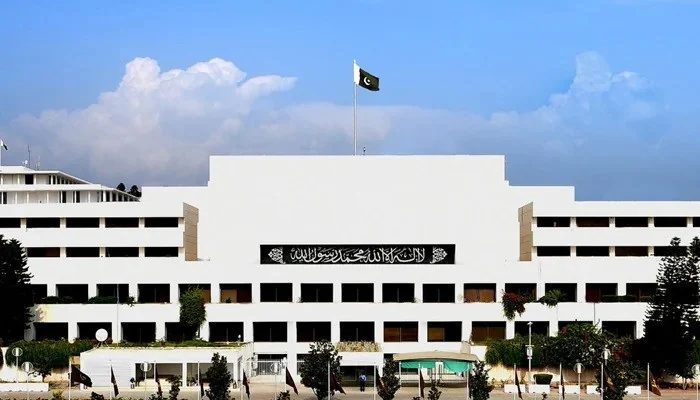
No proposal for any constitutional amendment, holding of referendum and electoral reforms is on the agenda of the upcoming National Assembly or Senate sessions commencing from November 16. Highly placed sources in the Parliament Secretariat told that the National Assembly session will start on Monday next and it would continue for two weeks.
Likewise, the Senate session will be commencing the same day. To a query, the sources maintained that the move for holding a referendum was the sole prerogative of the prime minister and the president had nothing to do with it.
It is the joint sitting of parliament that would consider and decide about the referendum. Article 48 (Clause 6) of the Constitution says, 'If the Prime Minister decides it is necessary to hold a referendum on any matter of national importance, he may refer the matter to a joint sitting of Parliament (Majlis-e-Shoora).'
The referendum proposal must first be approved by a joint sitting of Parliament. Once approved, the Prime Minister can cause the matter to be posed to the electorate as a question that can be answered with a simple 'Yes' or 'No'.
Interestingly, the current version of Article 48(6) was substituted by the Eighteenth Amendment Act, 2010, shifting the power to initiate a referendum to the prime minister (subject to joint parliamentary approval), whereas older iterations allowed the president acting in discretion or on advice to call one.
The sources pointed out that national referendums had historically been held under special or military-backed regimes (such as in 1984 under General Zia-ul-Haq and 2002 under General Pervez Musharraf), though the modern constitutional framework strictly required joint parliamentary consent. Both the referendums took place without approval or consent of the parliament since the Constitution was held in abeyance.
Meanwhile, political observers opine that passage of the proposal for holding a referendum on the question of new provinces/administrative units would be an uphill political task, even if the prime minister agreed to put it before the joint sitting. 'Such a proposal without assuring majority support could disturb the whole political applecart and new chaos could surface,' they view.
Pakistan Tehreek-e-Insaf (PTI) minus Imran Khan is willing to support such a proposal, but the ruling Pakistan Muslim League-Nawaz (PML-N) and Pakistan Peoples Party (PPP) alliance wouldn't like to become a party to it since both parties would lose their political strongholds in case of the dismemberment of the existing provincial arrangement.
It is understood that the 'reset' move would ultimately be shelved after acceptance of its first agenda item pertaining to the revision of the National Finance Commission (NFC) Award in the longer run, political observers opined.