
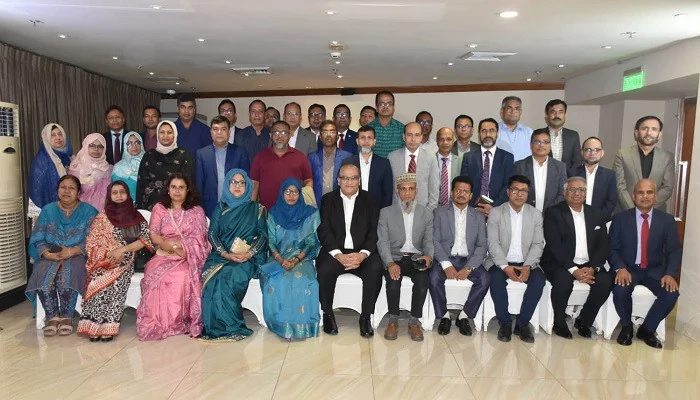
Efforts allegedly involving former Bangladeshi prime minister Sheikh Hasina and her Indian allies to obstruct the revival of Pakistan-Bangladesh relations have failed to derail growing institutional cooperation between the two countries, as 35 senior Bangladeshi civil servants have arrived in Pakistan to participate in a specialised executive leadership training programme under the Pakistan-Bangladesh Knowledge Corridor.
The delegation comprises 30 joint secretaries and five additional secretaries of the government of Bangladesh, who will undergo professional training at the National School of Public Policy's Executive Development Institute, Lahore. The programme aims to strengthen administrative capacity, promote institutional understanding and provide an opportunity for senior officials of both countries to exchange experiences regarding governance, public administration and emerging policy challenges.
The Executive Development Institute (EDI) of the National School of Public Policy is organising the two-week Executive Leadership Training Programme for the Bangladeshi delegation. The initiative is designed to familiarise participants with Pakistan's administrative experience, governance structures, institutional arrangements and public sector leadership practices, while providing opportunities for detailed interaction with experienced policymakers, parliamentarians and senior administrators.
An important feature of the programme is the involvement of Pakistan's parliamentary leadership as resource persons. In this connection, the Executive Development Institute has invited Punjab Assembly Speaker Malik Muhammad Ahmad Khan as the guest speaker to address the Bangladeshi civil servants on parliamentary governance, institutional coordination, legislation and accountability.
The proposed lecture will focus on two important themes including "The Legislature-Executive Relationship: Promoting Effective Governance and Institutional Coordination" and "Legislation, Accountability and Good Governance: Lessons from Punjab, Pakistan". The interaction is expected to provide the visiting officials with practical insights into the functioning of democratic institutions, legislative oversight and the relationship between different organs of the state.
It will also highlight Punjab's legislative and institutional experience in promoting accountability, effective governance and coordination between the legislature and executive. The latest programme represents a further expansion of Pakistan-Bangladesh institutional cooperation following the landmark visit of the first batch of senior Bangladeshi civil servants to Pakistan earlier this year.
The initial group of 12 officers received professional training at Pakistan's Civil Services Academy (CSA), Lahore, through its Walton and Pakistan Administrative Service (PAS) campuses. Their participation marked an important step towards restoring structured civil service training exchanges between the two countries after a prolonged interruption.
The first batch's training provided an opportunity for Bangladeshi officers to interact with their Pakistani counterparts, understand the country's civil service training system and exchange views on administrative practices, governance models and public-sector management. The successful completion of that programme paved the way for further engagement, with the latest delegation comprising 35 senior officials under the Pakistan-Bangladesh Knowledge Corridor.
Observers note that despite political shifts and external pressures, institutional linkages between Islamabad and Dhaka are gaining positive momentum, demonstrating the resilience of both nations in fostering bilateral ties.