
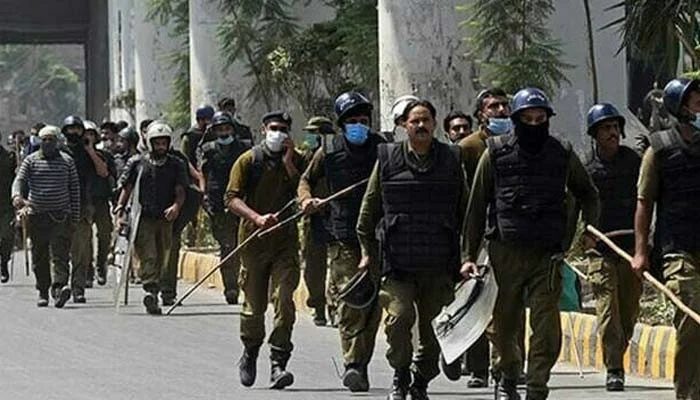
In less than 48 hours this week, two men at the centre of high-profile cases died at the hands of apparent police 'crossfire', and the police gave the same explanation both times. In Islamabad, Muhammad Nauman, accused in the case linked to the suicide of student Laiba Ejaz, was allegedly hit by his own accomplices' fire while police were taking him to recover evidence.
No policeman was hurt, however. A day later, Tauqeer Nazir, prime suspect in the killing of orphaned teenager Waseem Abbas in Multan, died in a Counter-Terrorism Department (CCD) encounter near Bahawalpur, allegedly from his accomplice's gunfire.
He had escaped from Multan's DHA police station while on a four-day physical remand. No explanation is available for how he escaped and reached Bahawalpur.
Meanwhile, the Human Rights Commission of Pakistan (HRCP) documented at least 670 CCD-led encounters in eight months of 2025, in which 924 suspects died, and only two police officers were killed. The HRCP's report for 2024 recorded 341 encounter deaths across Punjab and Sindh combined for the entire year.
The police story rarely changes: suspects' accomplices ambush the police party to free them, the police fire back, and the suspect is killed by their own accomplices' bullets, while the officers always escape unhurt. In October 2025, Islamabad police gave a near-identical account when two suspects in the murder of Capital Development Authority (CDA) Director Land Ehsan Elahi were found dead after their accomplices allegedly opened fire.
When the same improbable event happens hundreds of times, the story stops being probable. Several factors drive this trend.
The first cause is structural: investigation is weak, forensic capacity is thin, witnesses are intimidated, prosecution is under-resourced and trials drag on for years. The encounter has become a shortcut around a justice system the state has failed to repair.
The second is political ownership. The CCD was created in 2025 through an ordinance amending the Police Order 2002, and Punjab's leadership has hailed it as protecting citizens' lives and property.
Rana Sanaullah has defended it on the grounds that those killed were proclaimed offenders who did not submit to the law. When politicians condone extrajudicial outcomes and ignore process, policemen learn what is expected of them.
The third is the outrage economy. In the Laiba case, the prime minister directed Islamabad's police chief to ensure immediate arrest.
In Multan, CCTV footage of the boy being run over circulated widely. Under that kind of pressure, only a dead suspect is counted as service delivery.
Another issue is impunity. Punjab police's own figures recorded 2,246 suspects killed in 3,424 encounters between 1990 and mid-2005.
None of these cases produced a lasting deterrent, so each new one carries little fear for those who pull the trigger. Unsurprisingly, authorities apply the encounter approach selectively to suspects without money, connections or influential surnames.
In Karachi's Karsaz case, the accused was acquitted after an out-of-court settlement. The Shahzeb Khan murder case ended the same way, with Shahrukh Jatoi's acquittal in 2023.
The street learns a simple lesson: poor suspects are shot on some bypass road at night, while privileged ones walk free through legal compromises. Two legal systems, divided by class, damage the state's credibility more than any gang.
That these encounters are presented as a form of justice is a cruel joke on the public.