
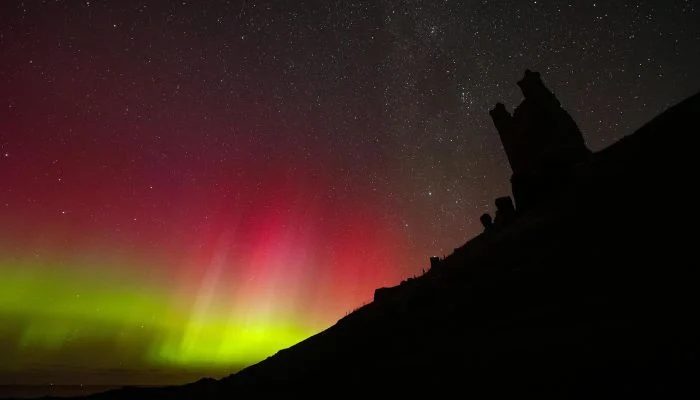
The northern lights may be visible across various parts of the northern USA Monday evening after the Earth experienced higher levels of geomagnetic activity due to an unusual G3 storm over the weekend. The National Oceanic and Atmospheric Administration (NOAA) Space Weather Prediction Centre predicted a Kp index of five out of nine for Monday night; thus, there may be more brightness and activity of the northern lights than normal.
The G3 storm conditions on Saturday were caused by a coronal mass ejection that hit Earth on October 10, following solar eruptions on October 7 and 8. While Monday is unlikely to witness a major geomagnetic storm, NOAA's three-day forecast suggests mild G1 storm activity may occur early Tuesday morning.
The NOAA forecast map indicates that aurora visibility will extend across US-Canada border states, including northern Washington, northern Idaho, Montana, North Dakota, most of Minnesota, northern Wisconsin, and the Upper Peninsula of Michigan. Parts of far northern South Dakota and Wyoming may also have viewing opportunities.
There is a high probability of occurrence across most of Alaska. Experts recommend traveling as far north as possible and securing a viewpoint facing north.
Aurora is easier to see during dark nights rather than full moon nights, with the best viewing times being around midnight. For photography, experts suggest using a smartphone's night mode without flash in RAW format.
Geomagnetic storms occur due to the interaction between solar charged particles and the Earth's magnetic field, creating colors in the sky. NOAA classifies these storms from G1 (minor) to G5 (extreme).
Space weather experts continue to monitor the sun's activity closely. As solar cycle 25 approaches its peak, such events are becoming more frequent.
Residents in the affected regions are advised to keep an eye on local weather updates and space weather alerts to maximize their chances of witnessing this natural phenomenon. The phenomenon, scientifically known as Aurora Borealis, is a result of solar wind interacting with the Earth's magnetosphere.
When these charged particles collide with oxygen and nitrogen atoms in the upper atmosphere, they release energy in the form of light, creating the spectacular displays often seen in polar regions. While the G3 storm has subsided, the lingering effects in the ionosphere can still provide favorable conditions for aurora sightings.
Observers are encouraged to find locations away from city lights to ensure the best possible visibility of the faint, dancing lights in the night sky. Safety remains a priority for those venturing out into remote areas at night.
Experts suggest dressing warmly and ensuring that vehicles are prepared for travel in northern climates, as temperatures can drop significantly during the late-night hours when aurora activity is at its peak. As the scientific community continues to study these solar events, the data collected from this week's activity will contribute to better predictive models for future geomagnetic storms, helping to protect satellite communications and power grids from potential disruptions.