
Pakistan's next economic shock may be triggered far beyond its borders, but its impact could be felt directly in household budgets, businesses and the country's already fragile external position. A prolonged disruption in the Strait of Hormuz could add an estimated $4.5 billion to the import bill, large enough to place renewed pressure on an economy still struggling to rebuild its external buffers and avoid another IMF adjustment. Energy shocks travel quickly; a spike in fuel prices raises transport costs, feeds into food and manufacturing prices, squeezes businesses, and reduces the purchasing power of working households. Pakistan has spent decades responding to these disruptions after they occur rather than building an energy system capable of absorbing them in the first place. Genuine macroeconomic stability will therefore remain elusive as long as economic growth is tied to expensive and volatile imported fossil fuels.
The immediate task is twofold: reduce the vulnerability of the fuel we still need to import while accelerating the transition toward energy we can produce domestically. The first step is therefore logistical. Pakistan has already explored having oil supplies rerouted through the Red Sea port of Yanbu, allowing shipments to bypass the Strait of Hormuz. Diversifying import routes and building alternative supply corridors can provide some insulation from sudden geopolitical disruptions. But they should be treated as strategic risk management. Rerouting imported fuel changes the route of dependence; it does not eliminate the dependence.
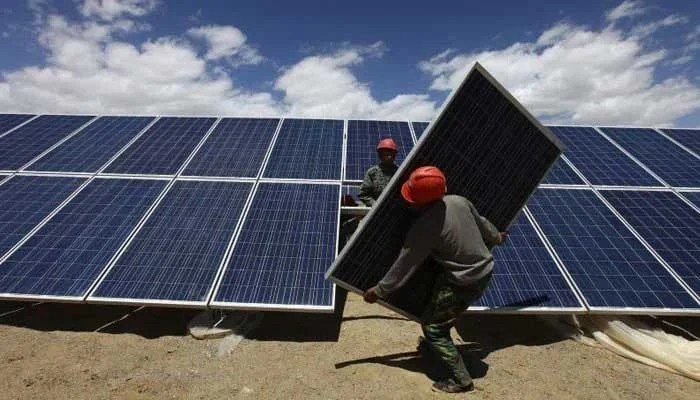
That distinction makes the longer-term transition far more important. Under China-Pakistan Economic Corridor (CPEC) 2.0, the proposed Green Corridor provides an opportunity to place renewable energy alongside industrialisation, agriculture, mining and digital cooperation at the centre of Pakistan-China economic engagement. Yet CPEC's first phase offers a warning about what happens when energy security is built around imported fuels. Coal's share of Pakistan's power mix rose from roughly 3.0 per cent to nearly 20 per cent in seven years, increasing exposure to international fuel prices, foreign-exchange pressures and the growing risk of stranded assets as global coal economics deteriorate. Expanding that model during a period of commodity and geopolitical uncertainty would only deepen vulnerabilities. Future capacity additions should therefore draw on Pakistan's substantial solar and wind resources, particularly in Sindh and Balochistan, while industrial zones should be designed around reliable, locally generated renewable electricity.
In principle, this could reduce exposure to international fuel markets, lower the foreign-exchange burden of energy imports and make Pakistan's industries more resilient to external shocks. In practice, however, renewables cannot compensate for the institutional inertia that has already prevented Pakistan's Special Economic Zones from becoming productive industrial ecosystems. Of the nine SEZs designated during the first phase of CPEC, only four - Rashakai in Khyber Pakhtunkhwa, Allama Iqbal Industrial City in Punjab, Dhabeji in Sindh, and Bostan in Balochistan - have progressed beyond the planning stage, with development remaining partial, largely because gaps in utilities, land-title security, approvals, electricity distribution and investor-developer dispute resolution continue to deter investment.