
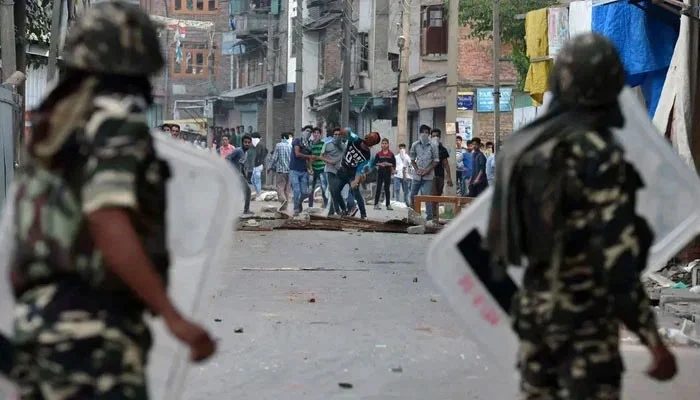
Seven years after India revoked Jammu and Kashmir's semi-autonomous status, public disaffection continues to grow despite improvements in security, while militant groups have evolved in both tactics and targets and gone underground. New Delhi's heavy-handed approach has failed to eliminate militancy and risks triggering renewed unrest, says the International Crisis Group (ICG) in a report.
Titled "A Trigger in Jammu and Kashmir: Militant Violence under Indian Central Rule", the report says a deadly terrorist attack in April 2025 triggered clashes between India and Pakistan that ended in a stalemate. "Another incident in Indian-administered Kashmir or elsewhere in India could trigger conflict between the two nuclear powers once again," the report warns.
It urges New Delhi to restore Jammu and Kashmir's statehood, return powers to regional authorities, and rein in the use of harsh anti-terror laws. It also calls on India and Pakistan to revive high-level back-channel diplomacy to reduce the risk of another confrontation.
"Seven years after New Delhi imposed far-reaching reforms in Jammu and Kashmir to counter militancy and usher in peace and stability, disaffection and alienation are quietly rising," said Praveen Donthi, the Crisis Group's senior analyst. He warned that unresolved grievances could undermine the region's superficial calm and urged India to restore statehood and both countries to reopen diplomatic channels.
Although militant violence, street demonstrations, and stone-throwing incidents have declined, the region remains vulnerable to renewed turbulence. The ICG argues that stability cannot be built on central rule, heavy-handed law enforcement, and counter-insurgency alone.
The report says public sympathy for militant groups has grown among some Kashmiris who see armed resistance as the only way to oppose New Delhi's policies. It argues that India must acknowledge the political grievances underlying the unrest rather than viewing militancy solely through a religious lens.
The report urges India to reconsider its position that Operation Sindoor has merely been paused, a stance that suggests military action could resume following another attack. While the approach is intended to strengthen deterrence, the ICG warns that it could keep India on a perpetual war footing and increase the danger of conflict with Pakistan, with potentially devastating consequences.
A senior leader of the Rashtriya Swayamsevak Sangh (RSS), the Bharatiya Janata Party (BJP) ideological parent organisation, has recently called for keeping the door to dialogue with Pakistan open while maintaining India's right to respond to alleged terror attacks. Given the RSS's influence, the position could help ease domestic opposition to engagement.
Pakistan has responded cautiously, with its foreign ministry waiting to see whether the call reflects India's official policy.