
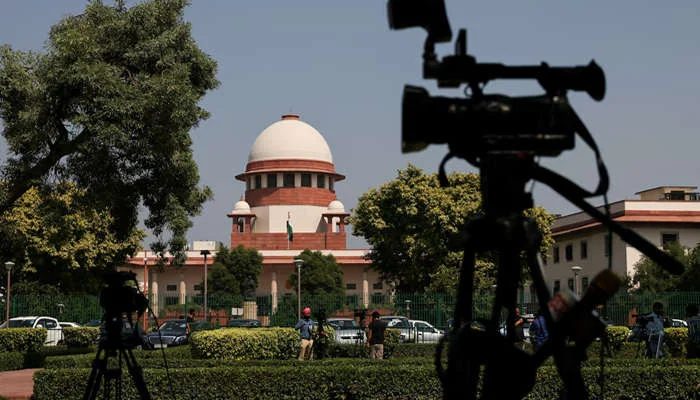
The Indian government's privacy law, which would require journalists to seek consent from subjects before publication, amounts to pre-censorship and could lead to newsroom closures, media groups told the Supreme Court on Tuesday. This marks the most high-profile legal challenge against the legislation to date.
The lawsuit arrives amid ongoing concerns regarding declining press freedom in India since Prime Minister Narendra Modi took office in 2014. While the government denies these allegations, claiming it upholds press freedom, critics argue that mainstream outlets have failed to sufficiently scrutinize the administration.
A coalition of 21 news publishers, including entities owned by billionaires Mukesh Ambani and Gautam Adani, argues that the law would stifle investigative journalism and allow New Delhi to compromise journalists' sources. Madhavi Goradia Divan, counsel for the Digital News Publishers Association (DNPA), told the bench, "It is changing the very concept of news.
If we are required to seek permission, newsrooms will shut down; it is a complete regime of pre-censorship." The Supreme Court has scheduled the next hearing for next month. Although media companies received verbal assurances in August that the law would protect press freedom, the absence of a written exemption for journalists - unlike in the European Union, Singapore, and Britain - remains a point of contention.
Publishers are demanding the repeal of key provisions set to take effect in May 2027, which could force the deletion of archived stories and empower the state to demand sensitive information. The DNPA includes major groups such as Ambani's Network18, Adani's NDTV, the Indian Express, and Times Internet, a subsidiary of the Times of India group.
Divan noted that while earlier drafts of the law explicitly excluded journalists, the final version removed these protections. Legal experts suggest that the outcome of this case will set a significant precedent for the future of digital media rights in the world's most populous nation.
The government maintains that the law is designed to protect the personal data of citizens in an increasingly digital economy. However, the petitioners argue that the lack of specific safeguards for the press creates a chilling effect on investigative reporting.
As the legal battle unfolds, international press freedom watchdogs are closely monitoring the proceedings. The tension between state-mandated data privacy and the fundamental right to report remains a central theme in the ongoing judicial discourse.
The court's decision to hear the matter indicates the gravity of the concerns raised by the media industry. With the May 2027 deadline looming, the pressure on the judiciary to provide clarity is mounting.
Ultimately, the resolution of this conflict will determine whether India's media landscape remains a space for robust inquiry or becomes constrained by stringent regulatory oversight that prioritizes state control over public interest journalism.