
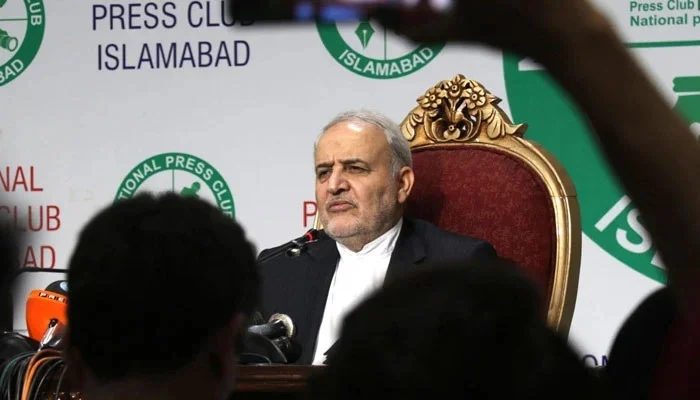
Iran is prepared to engage in talks with the United States under a Pakistan-brokered peace deal reached in June to end the ongoing conflict. Iran's Ambassador, Dr. Reza Amiri Moghadam, stated this while addressing a discussion at the Islamabad Club on Saturday evening.
The event, held under the auspices of the Forum for Information Group Secretaries (FIGS), was titled: "The US-Israel-Iran War and the Emerging Regional Alliances: More Disasters or Hope for Diplomacy?" The Iranian ambassador conveyed Tehran's willingness to reopen the Strait of Hormuz during visits to Tehran by Pakistan's Army Chief, General Syed Asim Munir, provided the US withdraws its blockade.
However, he accused US President Donald Trump of rejecting the proposal by insisting that the blockade of Iranian ports would continue. He stated that Washington is undermining diplomacy and prolonging the standoff.
Ambassador Moghadam affirmed that the Islamabad Memorandum of Understanding (MoU) remains valid, and Pakistan continues to play a central mediating role. He reiterated that Iran remains committed to its independent policies despite external pressure and sanctions.
Regarding the Makkah Joint Defence Agreement - which includes Pakistan, Saudi Arabia, and Turkey - Moghadam said Tehran would study the pact before deciding on its support, describing it as a potential instrument for unity. He also highlighted the Palestinian issue and Iran's opposition to Israeli policies as critical factors shaping regional confrontation.
Former Foreign Minister Inam-ul-Haq, former defence secretary Lieutenant General (retd) Khalid Naeem Lodhi, former ambassador Ashraf Jehangir Qazi, and former information secretaries Ashfaq Ahmad Gondal and Shafqat Jalil also addressed the session. Ambassador Ashraf Jehangir Qazi highlighted the diplomatic challenges Pakistan might face regarding Iran's potential inclusion in the Makkah Joint Defence Agreement.
Inam-ul-Haq urged Pakistan to pursue a balanced foreign policy and carefully assess its strategic commitments, while Lieutenant General (retd) Khalid Naeem Lodhi warned that further escalation could carry serious implications for regional and international security. The session concluded with a consensus that diplomatic channels must remain open to prevent a wider regional conflagration.
Experts emphasized that Pakistan's role as a bridge between major powers remains vital for regional stability. The participants agreed that the current geopolitical landscape requires cautious navigation, particularly as the Middle East faces unprecedented challenges to its security architecture.