
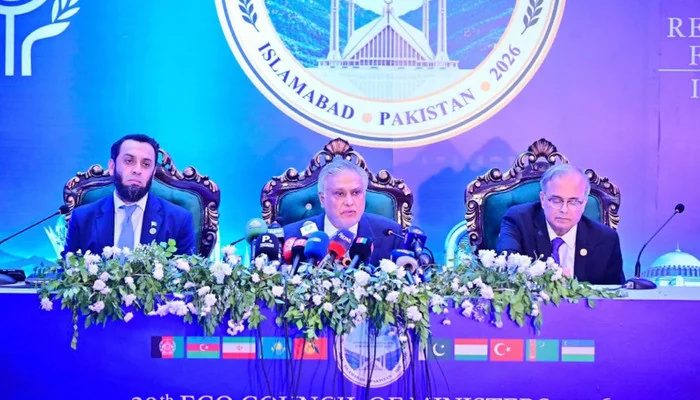
Deputy Prime Minister and Foreign Minister Ishaq Dar announced on Monday that Islamabad will host a high-level security committee meeting of the Makkah defence agreement later this month.
- Pakistan, Saudi Arabia, and Turkiye will hold the summit to discuss the trilateral defence pact.
- The agreement mandates mutual assistance if any signatory faces an armed attack or military aggression.
- The pact includes cooperation in intelligence sharing, military training, and defence industry development.
Makkah Defence Agreement Details
Addressing a press briefing following the Economic Cooperation Organisation ministerial meeting, Dar confirmed that the apex committee of the alliance will convene in Islamabad. The agreement, signed in Makkah on August 7, establishes a collective security mechanism among Pakistan, Saudi Arabia, and Turkiye. Dar stated that the pact aligns with Article 51 of the United Nations Charter, which recognizes the right to individual and collective self-defence. He emphasized that the agreement aims to strengthen regional security and does not signal a desire for confrontation with other nations.
The treaty stipulates that an attack on one member constitutes an attack on all three. Article 1 requires parties to use all necessary means to protect territorial integrity and sovereignty. Article 2 mandates immediate assistance if a signatory faces aggression from another country or group. The nature of this support will be determined through an objective assessment of requirements, utilizing available military capabilities. The pact remains in force indefinitely, with a ten-year bar on withdrawal. Any party wishing to leave after that period must provide three months of written notice.
Regional Security and Implementation
The alliance held its inaugural meeting in Istanbul on August 31. Officials are currently establishing an institutional framework, including a working committee composed of one Foreign Office representative, three secretaries, and one military official. The agreement covers intelligence sharing, logistical support, counterterrorism, and joint military training. Signatories must also protect classified information and prohibit its disclosure to third parties.
The regional security situation has deteriorated since the conflict began in February with US-Israeli strikes on Iran, which resulted in the death of Supreme Leader Ayatollah Ali Khamenei. Houthi rebels have repeatedly targeted Saudi oil facilities and shipping lanes. In response, the three alliance members agreed at a recent Riyadh meeting to ensure the rapid deployment of military forces to Saudi Arabia. Turkiye has condemned the attacks and pledged support for Saudi military technology requirements. Meanwhile, Iran continues to restrict traffic through the Strait of Hormuz and recently launched drone attacks against Bahrain. Turkiye's formal participation in the Makkah agreement remains subject to parliamentary ratification.