
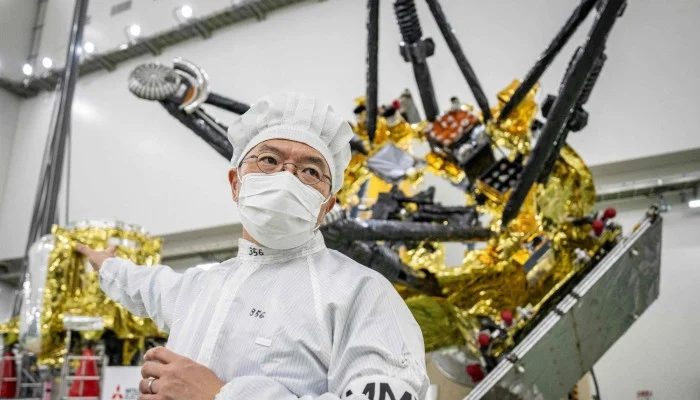
TOKYO: Japanese scientists are readying a mission to Mars's moons to retrieve samples that could help unlock the origins of the Solar System and life on Earth, in what aims to be the first round trip to the Martian region. The unmanned Martian Moons eXploration (MMX) probe, a collaboration with US and European space agencies as well as numerous universities and tech companies, could also help lay the groundwork for eventual human exploration.
The flagship H3 rocket carrying the MMX is set to blast off from the Tanegashima Space Centre Tuesday at 4:41am (1941 GMT Monday), according to the Japan Aerospace Exploration Agency (JAXA). The spacecraft will arrive near Mars one year later, where it will orbit its moon Phobos for up to three years before landing and collecting at least 10 grammes of material from the surface.
A rover dubbed IDEFIX will first conduct surface observations aimed at ensuring a safe landing. "The sampling from Phobos is of course the world's first, but it means this is the first round trip to the Martian system," MMX's project manager Yasuhiro Kawakatsu told JAXA, adding the mission will explore using Phobos as a "natural space station" for crewed Mars exploration.
It will also observe the moon Deimos before returning to Earth. JAXA hopes the mission will reveal how Mars and its moons formed, helping solve the "giant impact" or "capture" hypotheses.
Patrick Michel, an astrophysicist working on IDEFIX, noted that if these moons are remnants of early delivery systems, they may hold clues to the transport of materials key to the emergence of life. The mission involves CNES, DLR, NASA, ESA, and 20 other partners.
Japan's experience with the Hayabusa-2 mission, which returned 5.4 grammes of rock and dust, provides a strong foundation for this complex endeavor. The scientific community is closely watching this launch, as the data retrieved could redefine our understanding of planetary formation.
By analyzing the composition of Phobos, researchers hope to determine whether the moon was captured by Mars's gravity or formed from debris following a massive collision. The H3 rocket represents a significant leap in Japan's launch capabilities, designed to be more cost-effective and reliable for deep-space missions.
If successful, this mission will mark a milestone in international space cooperation. The return journey is the most challenging phase, requiring precise navigation to bring the samples back to Earth's atmosphere safely.
Scientists have spent years simulating the landing and retrieval processes to mitigate risks. As the countdown begins, the global space community remains optimistic about the potential discoveries that await.
This mission not only pushes the boundaries of technology but also brings humanity one step closer to understanding our place in the cosmos.