
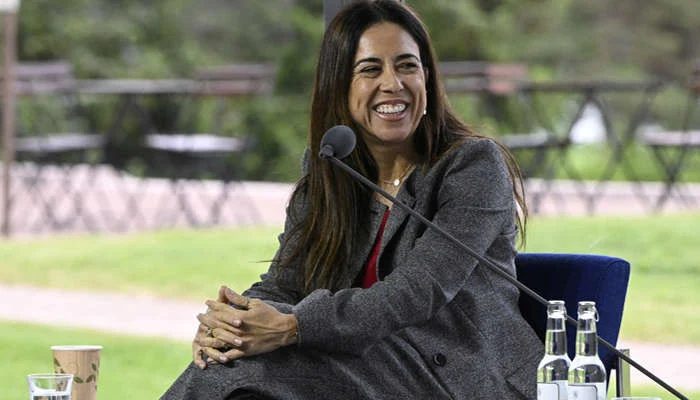
Lana Nusseibeh, an Emirati official with Palestinian roots, has emerged as a late frontrunner in the race to lead the United Nations, campaigning on a reformist agenda and vowing to work for peace. Since her official nomination on Wednesday, she has already garnered the backing of Gulf states.
If she succeeds, she would be the first woman and the second Arab to secure the position in what would be a tour de force for the United Arab Emirates (UAE), a Middle East power that faced Iranian tensions earlier this year.
In a campaign video, she vows if elected to "bring greater urgency to the work for peace" and "defend human rights." The 48-year-old diplomat projects the image of a modern Arab woman, a narrative her country has long sought to promote. "Lana Nusseibeh has a thick CV," said Emirati political science academic Abdulkhaleq Abdulla.
"She brings in the best of the UAE's diplomacy." She stepped down from her post as state minister at the foreign ministry and as envoy to the UN and EU to campaign for the top UN job. A seasoned diplomat, she served as the UAE's permanent representative to the UN from 2013 to 2024, the first woman to hold the post.
Her transition from a national representative to a global candidate marks a significant shift in regional influence. Nickolay Mladenov, the high representative for Gaza under a US-backed "Board of Peace," said Nusseibeh "does not give up when the room gets difficult." Nusseibeh comes from a prominent Palestinian family of statesmen, uprooted by the creation of Israel in 1948.
Her family traditionally held the keys to the Church of the Holy Sepulcher in the walled Old City of Jerusalem. Her grandfather was defence minister in Jordan in the 1950s, while her father Zaki Nusseibeh was an adviser and interpreter to the UAE's late founding president Sheikh Zayed.
She holds two master's degrees, including one in Israeli and Jewish diaspora studies from the University of London. Her academic background is often cited as a tool that helps her navigate complex geopolitical landscapes.
In the latest informal straw poll held last week to gauge candidates' prospects, every contender received an effective veto from the five permanent members of the UN Security Council. This indicates that the path to the Secretary-General position remains fraught with diplomatic hurdles.
Nusseibeh remains optimistic, focusing on building consensus among the P5 nations. Observers note that her candidacy represents a broader push by the UAE to play a central role in global governance.
By leveraging her experience in multilateral forums, she aims to bridge the gap between Western powers and the Global South. Her supporters argue that her unique background allows her to understand the nuances of the Middle East conflict better than most international bureaucrats.
The campaign is expected to intensify as the UN prepares for the next round of voting. Nusseibeh has been traveling extensively to secure support from African and Latin American nations, emphasizing that the UN needs a leader who understands the challenges of the 21st century.
Her platform focuses heavily on climate change, digital transformation, and the reform of international financial institutions. Critics, however, point to the complex regional dynamics that could complicate her bid.
The UAE's recent normalization of ties with Israel and its stance on regional security issues are topics that will likely be scrutinized during the upcoming debates. Despite this, Nusseibeh maintains that her priority is the collective security of the UN member states.
As the election date approaches, the international community watches closely. Whether Nusseibeh can overcome the veto power of the permanent members remains the biggest question.
For now, she continues to project confidence, positioning herself as the candidate of change in an organization often criticized for its slow pace of reform.