
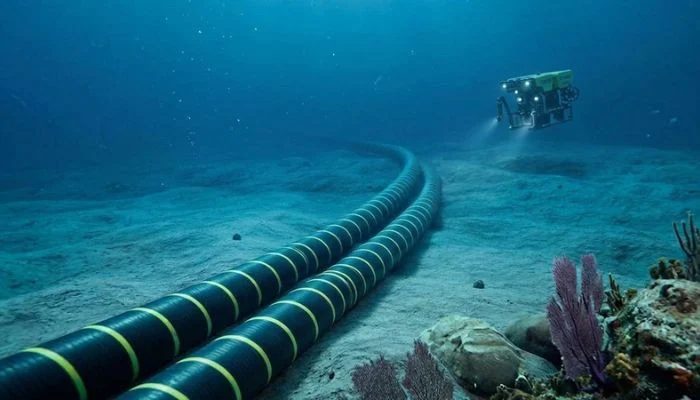
Meta Platforms, led by Mark Zuckerberg, is planning to build a 4,300-mile-long internet cable beneath the Atlantic Ocean capable of carrying enough data to allow nearly three-quarters of the world's population to stream music simultaneously. The cable, named Petal, will connect the United States and France with a capacity of one million gigabits per second, making it the first transoceanic cable designed to reach such speeds.
According to Live Science, the cable could transfer approximately 125 terabytes of data every second, equivalent to around 25,000 high-definition movies. The project is currently under development and is expected to become operational in 2029.
Meta Platforms claims Petal will carry twice as much data as the most advanced existing transoceanic cables without a proportional increase in power consumption. The company plans to achieve this using multi-core fibre technology, which allows two separate streams of light to travel through a single fibre strand.
Each strand will be approximately as thin as a human hair. Japanese technology company NEC will oversee the design and construction, while Sumitomo Electric will supply the optical fibre.
Despite the rise of satellite internet, undersea cables still carry approximately 99% of intercontinental internet traffic. Meta has previously invested in projects like Marea, Amitie, and Anjana to support its digital infrastructure.
The company is expanding its network capacity to meet the massive data demands of artificial intelligence (AI) services. Petal's advertised speed represents its total capacity rather than the internet speed individual users will receive at home.
Industry experts suggest that this project marks a significant shift in how global tech giants are securing their own infrastructure. By bypassing traditional telecommunications providers, Meta aims to ensure seamless connectivity for its platforms.
The environmental impact of such massive infrastructure is also being considered. Meta has stated that the efficiency of the new multi-core technology will help in reducing the carbon footprint per gigabit transferred.
As the world becomes increasingly reliant on cloud-based services, the demand for such high-capacity cables is expected to grow exponentially. Petal is just the beginning of a new generation of subsea infrastructure.
The project highlights the ongoing race among tech giants to dominate the digital backbone of the internet, ensuring that their services remain fast and reliable for billions of users worldwide.