
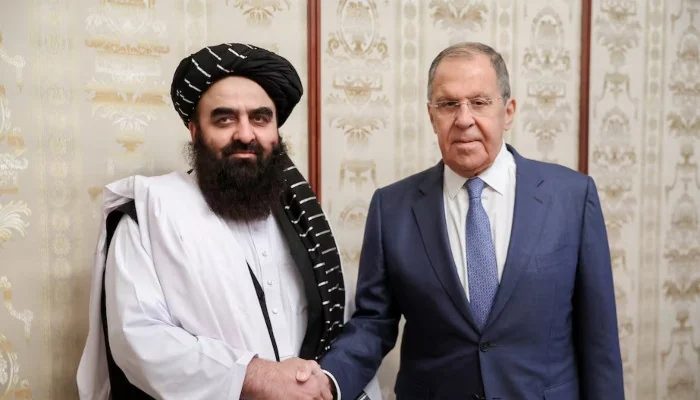
Afghanistan's diplomatic rehabilitation is advancing faster than its accountability for terrorism. Russia sees an opportunity to contain Islamic State Khorasan (IS-K) and deny the US a renewed strategic foothold.
Pakistan sees militant networks retaining the space to organise attacks across its border. The gap between these priorities exposes the central weakness in regional engagement with the Taliban: Kabul is gaining legitimacy without delivering security to its neighbours.
Russia's approach centres on IS-K and the possibility of renewed American strategic access. Pakistan confronts threats involving the Tehreek-e-Taliban Pakistan (TTP), the Baloch Liberation Army (BLA), Al-Qaeda and associated networks.
These priorities overlap, but action against IS-K cannot become a substitute for addressing organisations attacking Pakistan. Moscow's concerns are understandable; the March 2024 Crocus City Hall attack showed the Islamic State threat's reach.
Russia became the first country to recognise the Taliban government in July 2025, after lifting its domestic ban on the movement. Its engagement reflects an assessment that Afghanistan's rulers can help contain a common enemy.
That calculation has a fundamental weakness: the Taliban can fight an organisation threatening their rule while sheltering others attacking neighbouring countries. Hostility towards IS-K establishes neither a comprehensive counterterrorism policy nor a commitment to protecting Pakistan.
Geopolitical competition reinforces this selective approach. At the October 2025 Moscow Format consultations, regional participants opposed foreign military infrastructure in Afghanistan.
The declaration followed US President Donald Trump's expressed interest in recovering Bagram airbase. Pakistan's participation demonstrated that opposition to foreign basing can coexist with differences over Taliban conduct.
Moscow's posture suggests that denying Washington another strategic foothold is a priority. The danger arises when keeping America out becomes more urgent than compelling Kabul to dismantle terrorist infrastructure.
Pakistan cannot be expected to absorb the security costs of another power's geopolitical calculations. UN findings illustrate the problem.
The sanctions Monitoring Team's August 2026 report described continued Taliban support for the TTP alongside escalating attacks against Pakistan. It also recorded Taliban operations that weakened IS-K, while IS-K attacks declined inside Afghanistan but increased in Pakistan.
Security within Afghanistan, therefore, offered no assurance of regional safety. The report noted that BLA members trained alongside the TTP under Al-Qaeda trainers in Afghanistan, and shared logistical networks between IS-K and the BLA.
These assessments require investigation and demonstrate why different ideologies should not obscure the possibility of shared infrastructure. Afghanistan's finances expose another contradiction in the narrative of an isolated regime surviving independently.
According to the World Bank, domestic revenue reached 272.4 billion afghani ($4.03 billion) in FY2025, representing 19.8% of GDP - a 12.7% increase over FY2024. Regional capitals must confront these stark realities before offering uncritical diplomatic space.
Continued engagement without strict benchmarks will only embolden militant proxies across the border. Security frameworks must evolve to address the dual threats of state-sanctioned sanctuaries and cross-border terrorism.
Without a unified stance from neighboring countries, Afghanistan will remain a safe haven for global destabilisation. Real stability is impossible while regional powers prioritize short-term geopolitical gains over lasting peace.