
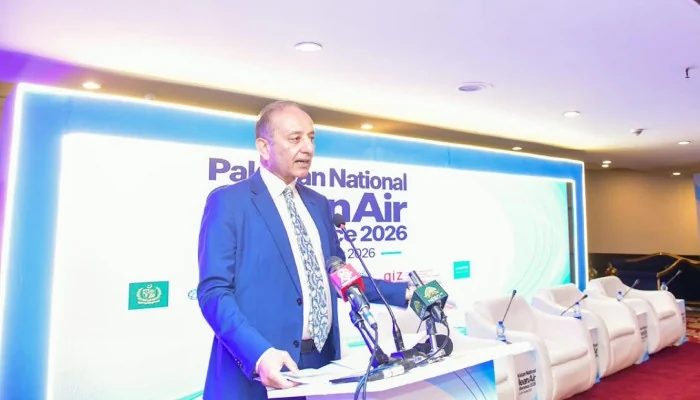
Climate change minister Dr. Musadik Malik on Wednesday announced a planned $10 million fund to support startups developing solutions to the country's air-quality crisis, saying the government will finance the initiative from its own limited resources while seeking support from development partners. Addressing the Pakistan National Clean Air Conference 2026 here, the minister said the proposed fund reflected the government's commitment to turning promises into practical action through technological innovation, effective policymaking, and investment in cleaner solutions.
He said the initiative was a responsibility towards future generations rather than a grant or loan, so the government would pursue it regardless of whether external assistance materialised. Dr. Malik said poor and vulnerable communities bore a disproportionate share of the health and economic costs of dirty air, while wealthier households could better afford protective measures such as air purifiers.
Describing the crisis as a consequence of policy choices and economic activities, he said those least able to protect themselves suffered its most severe effects. The minister estimated that poor air quality cost Pakistan 6.5 percent of its gross domestic product, reflecting the toll of illness, hospitalisation, and financial pressures on affected families.
Highlighting the health consequences, he referred to patients suffering from chronic obstructive pulmonary disease who depended on oxygen and medication. Dr. Malik also cited a UNICEF report documenting the harmful effects of dirty air on children's lung health and physical development.
He said schoolchildren travelling through polluted streets and people working outdoors remained particularly exposed. The minister said street vendors, farmers, and other outdoor workers faced heightened risks, while farmers who burned crop residue also suffered from the resulting smoke and deteriorating air quality.
He stressed that communities whose agricultural practices contributed to the problem were themselves among those affected, calling for solutions that protected public health without overlooking people's livelihoods. Describing clean air as a policy challenge rather than an unavoidable natural disaster, Dr. Malik said industrial activity and other human interventions had played a major role in creating the crisis.
He said effective interventions could address the problem if backed by sustained action. Citing the construction of the Karakoram Highway through difficult mountainous terrain and efforts to contain dengue as examples of challenges that could be overcome, the minister said Pakistan had the capacity to tackle its environmental problems through determination and innovation.
Referring to China's experience, he noted that Beijing and Shanghai had made progress in tackling poor air quality, while the country had emerged as a major exporter of solar technology. Dr. Malik said Pakistan could follow a similar path through sound policies, technological innovation, and collaboration with development partners.
He acknowledged the contributions of the World Bank, Asian Development Bank, UNICEF, and German development agency GIZ to climate-related initiatives. Emphasising the need to move beyond declarations, the minister said addressing the crisis required engineering solutions, sound policymaking, and financial commitments rather than slogans.