
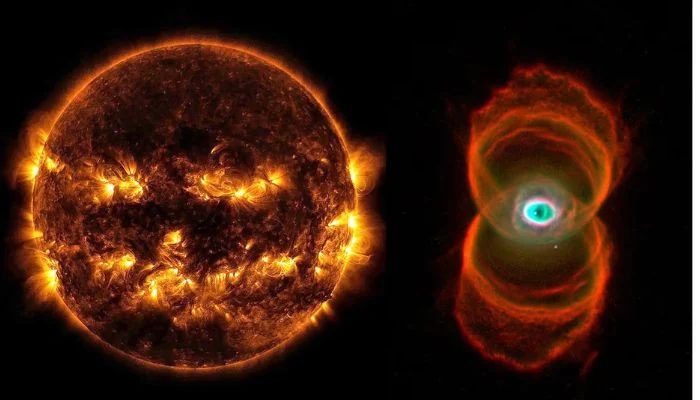
The National Aeronautics and Space Administration (NASA) is celebrating Halloween by sharing some of the most unusual and eerie images captured from across the cosmos. The newly released collection features a large skull, an enigmatic eye gazing into deep space, and a Sun with a smile, resembling a traditional Halloween pumpkin.
The American space agency published these images ahead of the festival to engage science enthusiasts and space lovers worldwide. One of the most striking photographs is of the Sun, which appears like a traditional jack-o'-lantern with two bright active regions acting as eyes and a crooked smile.
This iconic image was captured by NASA's Solar Dynamics Observatory (SDO) in October 2014, when the Sun's complex magnetic activity created unusually bright regions in its outer atmosphere. Scientists explain that these coronal holes and active regions naturally form patterns that our brains easily recognize as familiar shapes.
Another fascinating image depicts a turquoise-green gaseous formation resembling a vast cosmic eye. Known scientifically as the Hourglass Nebula or MyCn 18, this planetary nebula is located approximately 8,000 light-years away from Earth.
Captured by the legendary Hubble Space Telescope, the intricate structure is formed by expanding gas ejected from a dying central star during its final evolutionary stages. The symmetrical hourglass shape continues to puzzle astrophysicists studying stellar evolution.
NASA also included a haunting image of the Perseus galaxy cluster, where two massive dark cavities are surrounded by glowing X-rays, appearing remarkably like hollow eyes within a skeletal skull. Intense energetic activity around the supermassive black hole located at the center of this galaxy cluster created these gigantic cosmic voids.
The high-energy plasma interactions generate sound waves that travel through the cluster gas. Other remarkable images highlight an eye-like circumstellar disk structure surrounding the bright star Fomalhaut.
This dust ring has long been a subject of intense astronomical research regarding planetary formation. Additionally, the collection features the famous 'Face on Mars,' a geological landform in the Cydonia region of Mars that resembles a human face under specific low-angle lighting conditions and shadow alignments.
Space scientists emphasize that while these cosmic features make for entertaining Halloween themes, they also provide valuable scientific data about stellar physics, black hole mechanics, and the chemical evolution of galaxies across the universe.