
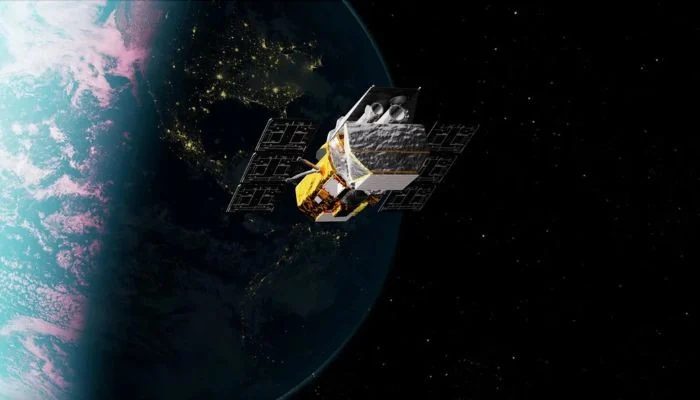
The National Aeronautics and Space Administration's (NASA) 22-year-old Swift Observatory is crashing back to Earth on Wednesday after a failed rescue attempt. The 1,450kg telescope is expected to re-enter Earth's atmosphere at around 3:30 am Eastern Time, although the American space agency has warned that the timing could vary by as much as 11 hours.
Most of the spacecraft will burn up during its fiery descent, but some components, including dense tungsten parts and pieces of its mirrors, could survive and reach the ground. NASA estimates the risk of anyone being harmed at approximately one in 2,100, and scientists have yet to determine exactly where any surviving debris might fall.
The telescope, launched in November 2004 to study powerful cosmic explosions, was originally expected to operate for just two years instead of spending more than two decades observing the universe. Its orbit began deteriorating faster than expected because of increased solar activity, prompting NASA to commission Arizona-based Katalyst Space to rescue the observatory.
The company's robotic spacecraft, LINK, launched in July with plans to capture Swift and push it into a higher orbit, but technical problems prevented LINK from completing the manoeuvre. This forced NASA to abandon the rescue in August, and the robotic spacecraft itself fell back to Earth in September while Swift continued collecting scientific data until October 20.
When its declining altitude forced operators to shut it down, the mission came to a close after unprecedented contributions to astrophysics and space research. During its lifetime, the observatory detected more than 2,000 gamma-ray bursts and 1,400 supernovae, helping scientists study black holes and other cosmic phenomena as one of NASA's longest-serving space telescopes.