Pakistan's New Energy Vehicle (NEV) Policy 2025-30, being integrated with the Automobile Policy 2026-31, aims to accelerate electric mobility, reduce the country's dependence on imported fuel and generate a projected net economic benefit of Rs732.8 billion by 2030, according to a government briefing. According to the official policy framework, which is likely to be discussed with the International Monetary Fund (IMF) during planned meetings in September, the government is targeting a 30 per cent share of NEVs in new vehicle sales by 2030. The transition is projected to save $0.95 billion in fuel costs, equivalent to 1.823 million tonnes of oil equivalent, over the policy period. Cumulative fuel-cost savings are estimated at Rs537.86 billion as the government seeks to ease pressure on the external account and make greater use of surplus electricity generation capacity.
The framework noted that Pakistan spent more than $16 billion on petroleum imports in 2024, while the transport sector accounts for up to 79 per cent of total oil demand. Transport oil consumption is projected to reach 18 million tonnes by 2030 unless the country succeeds in shifting towards alternative energy sources. Under the proposed framework, local NEV manufacturing will retain a concessionary one per cent customs duty on EV-specific assembly kits and localised components until June 30, 2027, while locally assembled NEVs will remain exempt from Federal Excise Duty (FED). Imported mass-market EVs priced below Rs20 million will face zero FED, while premium electric vehicles will attract FED ranging from 30-40 per cent. Local assemblers will also be required to increase localisation, with targets of 30 per cent by 2028 and 50 per cent by 2031.
To finance consumer incentives without placing an additional burden on the budget, the policy envisages a revenue-neutral mechanism funded through a one to three per cent levy on conventional internal-combustion-engine (ICE) vehicle sales. The levy is expected to generate Rs122 billion against a five-year subsidy allocation of Rs100.36 billion. The support will focus primarily on two- and three-wheelers and commercial four-wheelers rather than private cars. Two-wheelers will receive reference cash support of Rs65,000, while three-wheelers will qualify for Rs400,000. Taxis and ride-hailing vehicles will be eligible for Rs15,000 per kWh of battery capacity or five per cent of the invoice value, whichever is lower. The State Bank of Pakistan (SBP) is also introducing green auto financing to address the higher upfront cost of electric vehicles, which the briefing puts at 20-65 per cent above that of conventional vehicles.
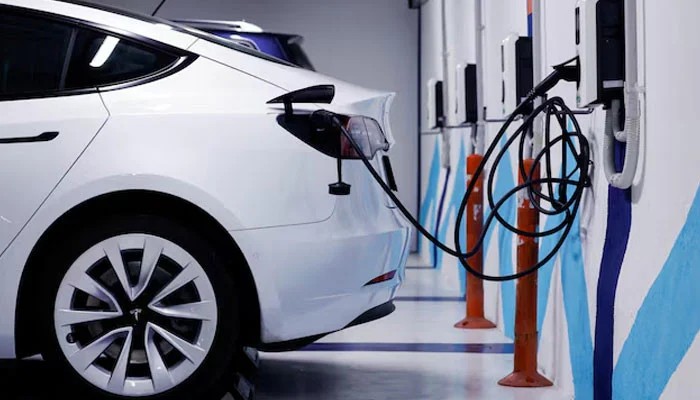
On charging infrastructure, the National Highway Authority is expected to install 40 Level 3 DC fast chargers along motorways and the N-5 within six months as the first phase of a larger programme. The government plans to establish 3,000 public charging stations by 2030 and has proposed a commercial charging tariff of Rs39.7 per kWh. The government estimates that the NEV transition could generate total socio-economic savings of Rs833.16 billion by 2030, alongside additional benefits such as increased electricity consumption, health dividends and international carbon credits.