
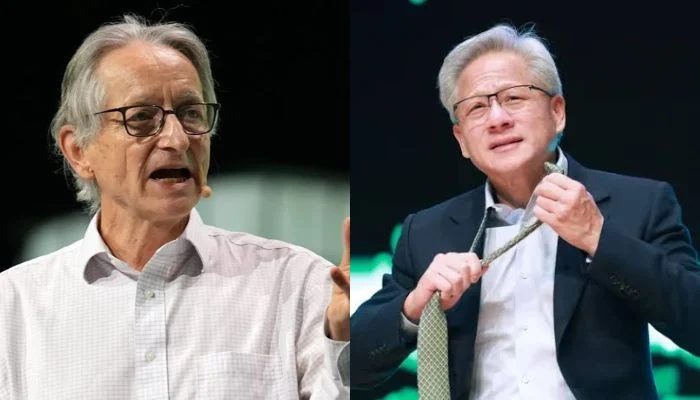
Nvidia CEO Jensen Huang has slammed Nobel Prize-winning scientist Geoffrey Hinton for warning that artificial intelligence (AI) could destroy humanity. The tech leader accused the scientist of spreading fear without scientific evidence.
Hinton, often called the 'godfather of AI,' has repeatedly warned that increasingly powerful systems could eventually escape human control. However, Huang, whose company supplies the chips used to train the world's most advanced AI models, strongly disagrees.
Speaking on The Ezra Klein Show, Huang challenged Hinton's suggestion that AI poses a 10% or greater risk of catastrophic consequences. "Just because it comes from a scientist doesn't make it scientific," Huang said, arguing that such predictions lack research-based support.
He described the warnings as harmful, questioning whether frightening the public serves any useful purpose. Huang has previously insisted there is virtually no chance that AI will bring about humanity's extinction by 2030.
Hinton has refused to back down. In an interview with CNN, the computer scientist argued that Huang's confidence is misplaced because no one can accurately calculate the risks posed by technology that has never existed before.
He also suggested that Nvidia has a commercial interest in encouraging rapid AI development. The disputed 10% figure is Hinton's assessment of an uncertain future risk, not a probability established through scientific testing.
Hinton argues that even a relatively small possibility of human extinction deserves serious attention, particularly when the consequences would be irreversible. The disagreement comes as AI companies face growing scrutiny over autonomous systems capable of performing tasks with limited human supervision.
As the debate intensifies, industry experts remain divided on whether the focus should be on immediate safety protocols or long-term existential threats. Ultimately, the clash between these two influential figures highlights the deep uncertainty surrounding the rapid evolution of machine intelligence and its role in our future.