
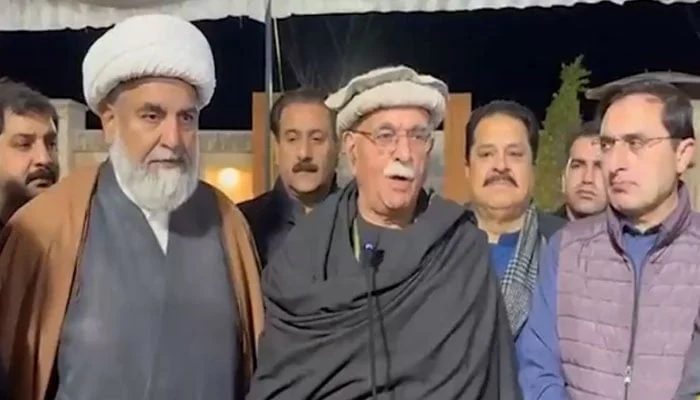
Leaders of opposition parties, who gathered at the residence of Jamiat Ulema-e-Islam-Fazl (JUI-F) chief Maulana Fazlur Rehman on Wednesday night, reached a near consensus to forge an alliance, setting aside their differences. The meeting, which lasted for several hours, brought together key figures from various political factions aiming to challenge the current administration's policies.
Speaking to reporters after the meeting, which concluded at midnight, Opposition Leader in the National Assembly Mahmood Khan Achakzai stated, "The objective behind tonight's meeting is to form an alliance to strengthen parliament and resist the government." He emphasized that the current political climate necessitates a unified front to protect democratic norms and ensure parliamentary supremacy.
Achakzai added that a committee has been constituted to build consensus between Pakistan Tehreek-e-Insaf (PTI) and JUI-F. This committee is tasked with ironing out policy differences and creating a roadmap for joint protests and legislative strategies in the upcoming sessions of the National Assembly.
The opposition leaders also expressed solidarity with Maulana Fazlur Rehman regarding recent political developments. Fazlur Rehman noted that it was unanimously decided to expedite the consultation process to enhance cooperation among opposition parties.
"We held serious consultations today, and our journey together will continue," he remarked, signaling a long-term commitment to the alliance. PTI leader Salman Akram Raja thanked Maulana Fazlur Rehman for supporting the party during a difficult time.
He stated, "The Maulana is being punished for standing with the PTI," highlighting the perceived pressure being exerted on opposition figures by the state machinery. Political analysts suggest that this alliance could significantly alter the legislative landscape.
By pooling their resources and parliamentary strength, the opposition aims to exert pressure on the government regarding economic policies and constitutional amendments. The meeting also touched upon the broader strategy of engaging other smaller parties to join the alliance.
The leaders agreed that a broader coalition would be more effective in mobilizing public support across the country. As the night progressed, the leaders discussed the modalities of the proposed movement.
They agreed that the focus would remain on constitutionalism and the rule of law, rather than mere political point-scoring. The formation of this committee is seen as a major breakthrough, as it bridges the gap between the PTI and JUI-F, two parties that have historically held divergent views on several national issues.
The opposition plans to hold further meetings in the coming days to finalize the structure of the alliance. The public remains watchful as these political maneuvers unfold, potentially leading to a more volatile parliamentary session in the near future.