
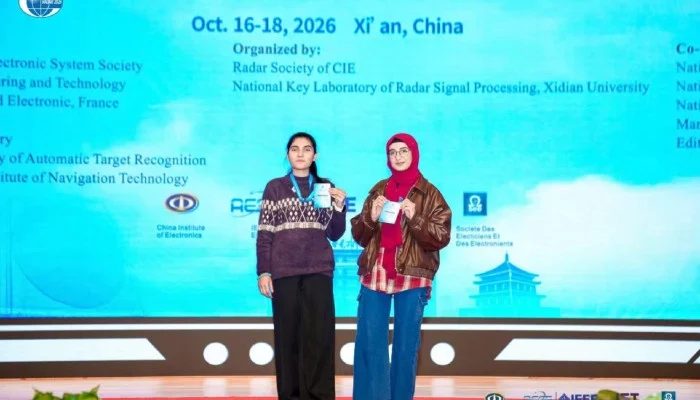
Pakistani scholars took part in the 2026 CIE International Conference on Radar held in Xi'an, Shaanxi, China, as the event drew experts from 29 countries and regions and set new records for submissions and attendance. The conference was organized by the Radar Society of CIE and the National Key Laboratory of Radar Signal Processing at Xidian University.
Pakistani participants, including Sana Akbar, a PhD scholar in Information and Communication Engineering, and Ilham Ali, a master's student in Optical Engineering - both from Xidian University - said they gained valuable exposure to international research developments in radar technology, electronic systems, and advanced engineering.
The conference featured seven core thematic forums and 14 specialized sub-sessions covering antenna and microwave technology, intelligent radar signal processing, integrated sensing and communication, radar imaging, and radar system applications. A total of 1,520 academic papers were submitted from 12 countries and regions.
Organizers noted that the international gathering provided a unique platform for researchers, engineers, and industry professionals to exchange cutting-edge ideas, foster collaboration, and discuss the future trajectory of radar science and electronic warfare systems. Sana Akbar and Ilham Ali presented insights from their ongoing research projects and interacted with leading global scientists.
They emphasized that such international academic engagements are crucial for Pakistani students pursuing higher education abroad to showcase their work and build networks. The event also highlighted breakthroughs in artificial intelligence integration with radar, cognitive radar systems, and millimeter-wave technologies.
Experts underscored the growing importance of dual-use technologies in modern civilian and defense applications. Delegates from various nations praised the organizational standards of Xidian University and the local authorities in Shaanxi province for facilitating a seamless academic exchange program despite logistical complexities.
Academic partnerships between Pakistani universities and Chinese institutions have expanded significantly under bilateral educational frameworks, facilitating numerous scholarships and joint research initiatives in engineering and technology disciplines. The conclusion of the conference marked the announcement of several collaborative research grants and future symposium dates, ensuring sustained dialogue among participating nations in the coming years.
Pakistani researchers returned to their respective departments with renewed academic vigor, aiming to apply the methodologies learned at the conference to domestic technological advancements and engineering curricula.