
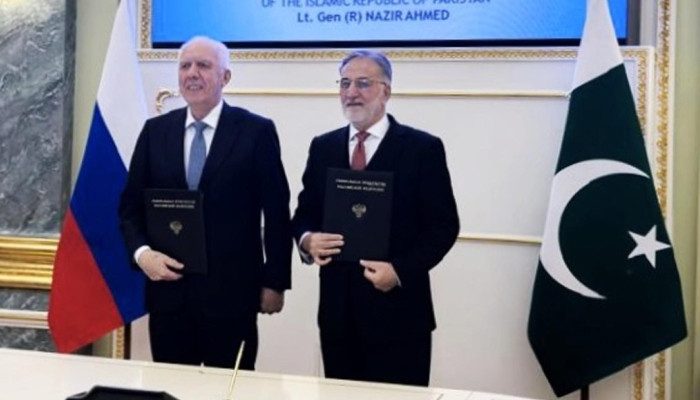
The National Accountability Bureau (NAB) and the Prosecutor General's Office of the Russian Federation have signed a Memorandum of Understanding (MoU) in Moscow to strengthen bilateral cooperation and enhance joint efforts to combat corruption and money laundering. This agreement marks an important step towards reinforcing institutional linkages and international collaboration in the field of accountability.
The MoU was signed by Chairman NAB Lt Gen (retd) Nazir Ahmed and Russian Prosecutor General Aleksandr Vladimirovich Gutsan, formalizing the commitment of both institutions to promote transparency, accountability, and the rule of law through sustained cooperation. The agreement provides a comprehensive framework for cooperation, encompassing the exchange of experience, expertise, and best practices in combating corruption and money laundering.
Furthermore, the framework includes the sharing of information on legal systems and legislation, and mutual consultations on legal matters relating to mutual legal assistance in criminal cases and law-enforcement cooperation. Both sides emphasized that this partnership is essential for addressing the evolving challenges posed by transnational financial crimes.
The MoU also envisages joint international conferences, workshops, working meetings, and round tables, reciprocal expert visits, and cooperation in professional training and capacity building of personnel. A significant dimension of the agreement relates to coordinated efforts for tracing and recovering assets derived from corrupt practices and money laundering.
Furthermore, the two institutions have agreed to undertake joint initiatives to promote anti-corruption awareness among young people, alongside collaborative scientific research in the field of combating corruption. This proactive approach aims to foster a culture of integrity and transparency within the younger generation.
The signing of the MoU reflects the shared resolve of Pakistan and the Russian Federation to strengthen institutional cooperation, promote professional exchange, and contribute to international efforts against corruption and financial crimes. By aligning their strategies, both nations aim to create a more robust defense against illicit financial flows.
It is expected that this agreement will provide a practical framework for sustained engagement, capacity building, and more effective cross-border cooperation. The implementation of these measures will be monitored by designated focal persons from both organizations to ensure the objectives are met within the stipulated timelines.
This development is being viewed as a positive signal for diplomatic and legal relations between Islamabad and Moscow. As both countries seek to modernize their anti-corruption frameworks, the exchange of technical knowledge will prove vital for the success of their respective national accountability agendas.
The collaboration is also expected to facilitate the sharing of digital forensic techniques, which are increasingly critical in tracking modern money laundering operations. Both parties expressed optimism that this partnership will yield tangible results in the near future.
In conclusion, the formalization of this relationship underscores the global necessity of unified action against financial corruption. Pakistan and Russia remain committed to upholding the highest standards of legal integrity through this strategic partnership.