
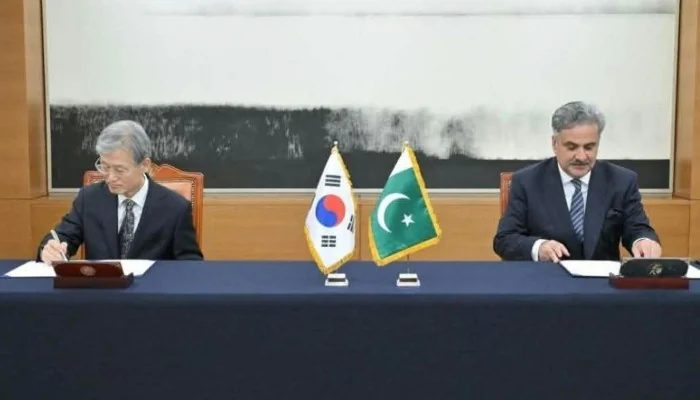
The Supreme Court of Pakistan and the Supreme Court of the Republic of Korea on Friday signed a memorandum of understanding (MoU) on bilateral judicial cooperation, paving the way for greater institutional collaboration, judicial knowledge-sharing, and technological innovation. Chief Justice of Pakistan (CJP) Justice Yahya Afridi, who is on an official visit to South Korea, was received by Chief Justice of the Supreme Court of the Republic of Korea, Justice Jo Hee-de, at the Korean Supreme Court in Seoul.
The two chief justices held substantive discussions on strengthening institutional ties, promoting mutual learning, and exploring avenues for closer cooperation between the two judiciaries. The MoU establishes a comprehensive framework for sustained institutional engagement, covering judicial exchanges, professional capacity-building, judicial education, collaborative research, and the sharing of institutional experiences and best practices.
During the meeting, Justice Yahya Afridi emphasized the importance of modernizing judicial systems through digital transformation. He noted that Pakistan is keen to learn from South Korea's advanced electronic court management systems, which have significantly reduced case backlogs and improved transparency.
Chief Justice Jo Hee-de welcomed the initiative, stating that the exchange of legal expertise would benefit both nations. He highlighted that the Korean judiciary has invested heavily in artificial intelligence and data-driven case processing, technologies that could serve as a model for Pakistan's ongoing judicial reforms.
The agreement also includes provisions for regular judicial conferences and workshops. These events will allow judges and legal experts from both countries to discuss emerging legal challenges, including cybercrime, international commercial arbitration, and environmental law.
Both sides agreed that the independence of the judiciary is a cornerstone of democracy. They reaffirmed their commitment to upholding the rule of law and ensuring that judicial processes remain accessible, efficient, and fair for all citizens.
The visit is being viewed as a significant step in strengthening diplomatic and institutional relations between Islamabad and Seoul. Officials from both countries expressed optimism that this partnership will yield long-term benefits for the legal fraternity.
As part of the visit, the Pakistani delegation also toured the Supreme Court's digital archives and research facilities. The delegation was briefed on how South Korea manages its vast database of legal precedents and judicial rulings.
The signing ceremony concluded with an exchange of souvenirs, marking a new chapter in the judicial history of both nations. The CJP is expected to return to Pakistan early next week to oversee the implementation of the newly signed framework.