
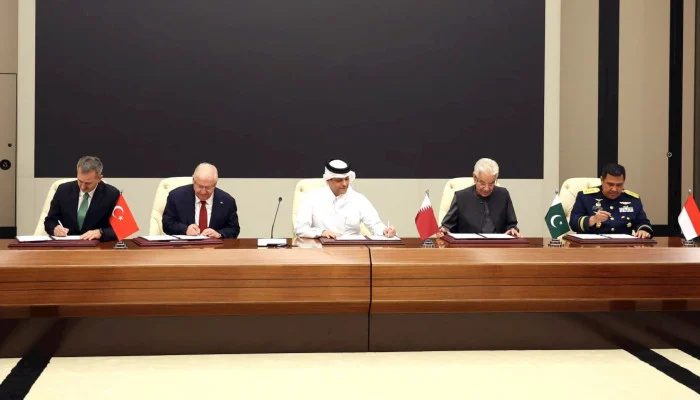
ANKARA: Pakistan, Turkey, Qatar, and Indonesia signed an agreement on Wednesday to boost defence cooperation and strengthen defensive capabilities, the Turkish Defence Ministry said. In a statement, the ministry said the countries signed the "Badr Memorandum of Understanding" in Doha as a sign of their desire to further deepen cooperation and develop partnerships.
"The agreement holds substantial economic importance," it said, adding the accord sought to foster cooperation in military production, boost military capabilities, and help collaboration in technical military training, research and development. "By leveraging the unique military production capabilities of each country, the initiative will facilitate cooperation and integration, enhance defence industrial capacities, and enable the fulfilment of the needs of allied and friendly nations," it added.
Turkey, which has the North Atlantic Treaty Organization (NATO) second-largest army and a robust defence industry, has been helping Gulf nations, including Qatar, where it has a military base, bolster their defences amid regional tensions. In August, it signed a mutual defence pact with nuclear-armed Pakistan and Saudi Arabia, under which an attack on one party constitutes an attack on all.
Ankara also has close ties with Indonesia, notably in the defence industry. The ministry said the Badr accord would strengthen ties between the countries' defence industries and bolster collaboration to promote security and achieve shared objectives.
The signing ceremony, held in the Qatari capital, was attended by high-ranking military officials and defence ministers from all four participating nations. This strategic alignment is seen as a significant move toward regional stability.
Experts suggest that the Badr Memorandum of Understanding will serve as a framework for future joint ventures in aerospace and naval technology, areas where Turkey and Pakistan have already demonstrated significant progress. The collaborative effort is expected to reduce reliance on external suppliers for critical military hardware, thereby enhancing the strategic autonomy of the signatory nations.
As global security dynamics shift, this four-nation bloc aims to create a unified front that can address emerging threats through shared intelligence and technological exchange.