
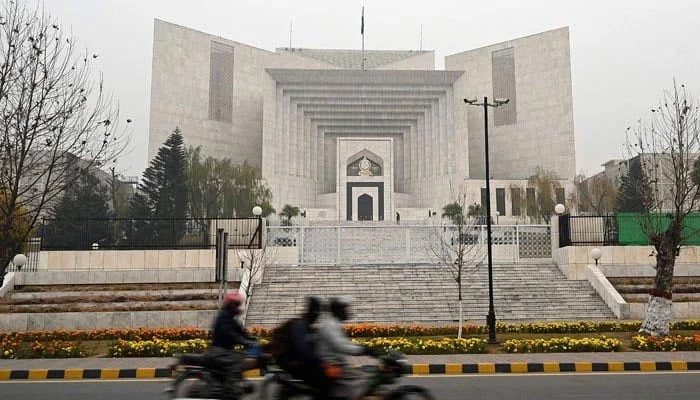
The Punjab government has suggested to the Supreme Court (SC) that sentences should not be ordered to run consecutively in every run-of-the-mill case, but rather in crimes that shock the public conscience. The provincial government submitted its reply in a case regarding the consecutive or concurrent serving of life imprisonment sentences for multiple murders.
A seven-member larger bench, headed by Justice Jamal Khan Mandokhel, is reviewing two major legal questions: 1. Whether the court of sessions, while convicting and sentencing an accused on more than one count, is mandated to direct the running of sentences consecutively or concurrently? 2.
Whether the gravity of the offence can be taken into consideration while deciding this? The Punjab government, through Additional Prosecutor Tariq Siddiqui, submitted that Article 10-A of the Constitution, Section 367 of the Code of Criminal Procedure (CrPC), and Section 24-A of the General Clauses Act, 1978, cast a legal obligation on the court to pass a speaking order regarding the concurrent or consecutive running of sentences.
This enables an appellate court to evaluate whether the discretion exercised by the subordinate court is legally justifiable. It submitted that according to Section 4 of the Punjab Sentencing Act, 2019, the purpose of sentencing is punishment, deterrence, reform, and public protection.
Therefore, consecutive sentences should be reserved for exceptional cases where the offence is perpetrated in a morbid, brutal, and inhuman manner, such as homicide, kidnapping, sexual abuse, and terrorism. The response further argued that consecutive sentences in grave, sensational, and inhuman cases would foster public faith in the justice system and maintain societal equilibrium.
It was submitted that the Bashir case (PLD 1991 SC 1145) is an illuminating judgment on the interpretation of Section 35 of the CrPC. It requested that Paragraph 40 of the Shah Hussain judgment (PLD 2009 SC 460) be declared per incuriam as it was passed in ignorance of the Bashir case ratio.
The court was informed that the controversy between the Bashir case and the Shah Hussain judgment has already been resolved by a three-member bench in the Qaisar Mehmood case (PLD 2026 SC 398). The provincial government emphasized that judicial discretion must be exercised with caution.
By limiting consecutive sentences to the most heinous crimes, the judiciary can ensure that the punishment remains proportional to the gravity of the act, thereby upholding the principles of natural justice. Legal experts observing the proceedings noted that this clarification is vital for the uniformity of sentencing across the country.
The SC bench is expected to deliberate on these submissions in the upcoming hearings to provide a definitive guideline for lower courts. The hearing of the case was adjourned as the bench continues to examine the constitutional implications of the arguments presented by the provincial authorities and other stakeholders involved in the matter.