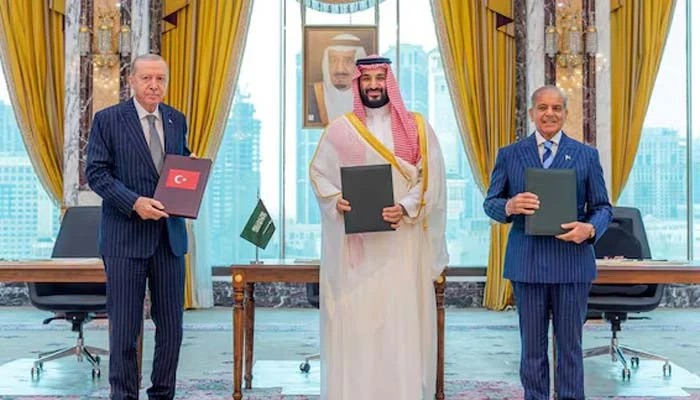
The Makkah Joint Defence Agreement between Pakistan, Saudi Arabia and Turkiye is significant not because Muslim countries have never attempted collective security before, which they have. Its importance lies in the three states coming together, the strategic moment at which they have done so, and their movement from longstanding bilateral defence relationships towards an institutionalised, regionally conceived and regionally owned collective-security framework. Pakistan's relationship with the wider Muslim region has always been multidimensional -- ideological and civilisational, political, security-based, economic and also consistently people-based. From Saudi Arabia and the Gulf through Iran and Turkiye, extending towards the Levant and North Africa, and eastwards to Malaysia and Indonesia, Pakistan has accumulated relationships over decades that transcend conventional interstate diplomacy. Millions of Pakistanis have lived and worked in the Gulf, contributing to these economies while their remittances became important to Pakistan.
Alongside these human connections grew institutional ones: military training, exercises, security cooperation, defence sales and Pakistani personnel assisting friendly states in developing their capabilities. Saudi-Pakistan defence ties, in particular, go back decades. Pakistan-Turkiye defence cooperation has meanwhile expanded into exercises, platforms, technology and defence production. The Makkah Agreement therefore represents continuity before it represents change. But it transforms that continuity into something strategically new. The immediate trajectory of Makkah begins with the extraordinary events of May and June 2025. Pakistan's May confrontation with India demonstrated its capacity to respond militarily to a considerably larger adversary, combining conventional capability with technology, electronic warfare, air power and integrated command.
Whatever competing narratives subsequently emerged, Pakistan came out of that confrontation with enhanced strategic confidence and renewed positive international attention. Then Israel attacked Iran in June. Pakistan took a clear position: it condemned the attacks as violations of Iranian sovereignty and international law, supported Iran's right of self-defence, but simultaneously pushed de-escalation and diplomacy. The diplomatic choreography was remarkable. On June 18, Field Marshal Asim Munir met US President Donald Trump at an unprecedented White House luncheon where the escalating Iran-Israel confrontation was discussed. The Chief of Army Staff (COAS) then travelled to Istanbul, where he and Foreign Minister Ishaq Dar met Turkish President Recep Tayyip Erdogan during the Organisation of Islamic Cooperation (OIC) gathering.
Turkiye's official account records Erdogan warning that Israel's attacks on Iran created risks for both Turkiye and Pakistan as Iran's neighbours, while advocating renewed US-Iran diplomacy. When the United States subsequently attacked Iranian nuclear facilities, Pakistan condemned Washington's action too. Pakistan had demonstrated military credibility against India. It was engaging Washington at the highest level while disagreeing with Washington and Israel over Iran; retaining its historic security relationship with Saudi Arabia while maintaining relations with Tehran; and coordinating increasingly closely with Turkiye. May-June 2025 was therefore the strategic inflection point, and by 2026 the concept of the extended security perimeter became a concrete reality, establishing that regional states can no longer afford to remain detached from wider geopolitical shifts.