
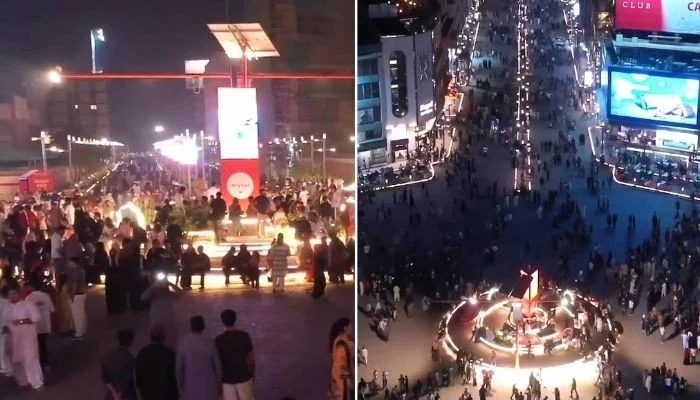
Karachi's newly developed Sindhi Muslim food walk has sparked controversy after visitors were reportedly asked to pay Rs600 merely to sit on chairs without ordering food, raising questions about the use of public space. The seating charges came to light when Geo Digital investigated complaints about restaurants demanding payment from visitors who wanted to sit without purchasing food or beverages.
Speaking to Geo Digital, a restaurant staff member maintained that the Rs600 charge was linked to monthly fees allegedly collected from restaurants by the Karachi Metropolitan Corporation (KMC) and the relevant Town Municipal Corporation (TMC) for tables and chairs. The tables and chairs have been placed along a renovated pathway developed as part of the food walk project, which was intended to provide space for pedestrians and outdoor dining.
However, visitors wishing to use the seating without placing an order are reportedly being asked to pay Rs600. Responding to a post on social media, TMC Chanesaar Town clarified that the food walk fell within its jurisdiction but denied that either the town administration or the KMC was collecting fees from restaurants for using the space.
The town administration also encouraged citizens to submit written complaints or photographic evidence against restaurants demanding such charges, saying explanations would be sought from the establishments concerned. Meanwhile, a social media user responding to the post said they had also been asked to pay Rs600 to sit on the chairs.
Expressing disappointment, the user questioned whether middle-class families unable to afford additional spending on food and beverages were effectively being discouraged from visiting the newly developed public space. The controversy extends beyond seating charges, with traders reportedly facing difficulties following the food walk's inauguration.
A source, speaking to Geo Digital on condition of anonymity, said traders were being pressured to enter into agreements with the town administration for installing billboards along the food walk, reportedly modelled on streets in New York and Türkiye. The source also maintained that restaurant sales had declined since the inauguration, citing parking arrangements as one of the contributing factors.
These assertions could not be independently verified. The redevelopment has also drawn criticism from residents of the surrounding neighbourhoods, who say the changes have disrupted traffic movement and daily life.
Speaking to Geo Digital, PECHS resident Ghulam Hassan said the closure of the Sindhi Muslim food street to vehicular traffic had shifted congestion into nearby residential streets. "We have been living here for 40 years.
This is not a new food street," Hassan said. He recalled that residents and restaurant visitors had faced considerable inconvenience during the reconstruction period because the road had been dug up, making access to the area difficult.
"We hoped something better was coming. But since its inauguration, this road has turned into a fish market," he said, referring to the congestion and disorder in the area.
Hassan said increased traffic pressure had resulted in vehicles crowding the streets of PECHS and surrounding areas. He also expressed concerns about security, referring to reports of mobile phone thefts during the food walk's inauguration.
The resident feared that increased activity and congestion could contribute to further incidents of theft.