
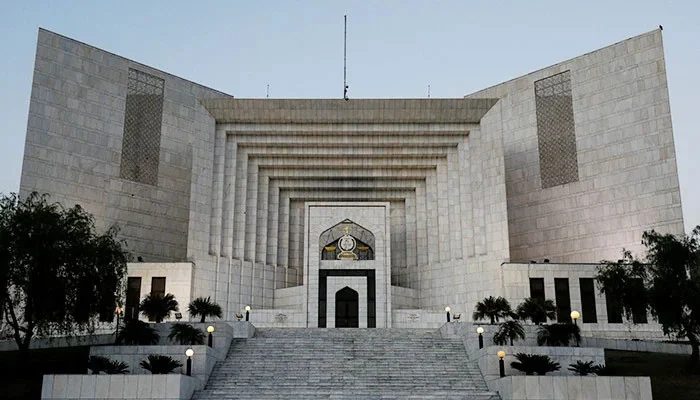
The Supreme Court on Tuesday acquitted a man convicted of murdering a 25-year-old woman, giving him the benefit of the doubt. A two-member bench of the apex court, comprising Justice Malik Shahzad Ahmed Khan and Justice Shakeel Ahmed, allowed the appeal filed by accused Munawar Hussain and set aside the judgments of both the trial court and the High Court.
The court ordered the accused to be released if he was not wanted in any other case. The victim was murdered with knife blows in a village in Faisalabad in 2016.
The trial court had sentenced the accused to life imprisonment, while the High Court had upheld his conviction. During the hearing, the counsel for the complainant contended that the accused had murdered 25-year-old Saima Bibi by slitting her throat with a knife.
The counsel told the court the accused was the victim's neighbour and had an improper interest in her. He added the victim's husband, brother-in-law, and a third person had also witnessed the incident.
Justice Malik Shahzad Ahmed Khan observed that, according to the First Information Report (FIR), the accused had acted alone despite the presence of three eyewitnesses. "Why did the husband, brother-in-law, and the third person not stop the accused during the incident?" Justice Malik Shahzad questioned.
The judge observed that the eyewitnesses had stood by silently and watched while the victim's throat was being slit. Justice Malik Shahzad noted that the High Court had not found allegations regarding the accused's improper advances towards the victim and the recovery of the knife to be reliable in its judgment.
Separately, while hearing a cheque dishonour case, the Supreme Court expressed displeasure over the failure of the Punjab Police to arrest the accused despite the rejection of bail applications by the trial court and the High Court. The court was informed that the accused's bail applications had been dismissed by both the district judiciary and the High Court, but the police were not arresting him.
Justice Shahzad remarked that failure to arrest the accused after the rejection of bail applications had become a routine for Punjab Police, not only in cheque dishonour cases but also in serious criminal cases, including murder. The counsel withdrew the bail application, and after the accused agreed to surrender to the police, the court disposed of the petition.
During the hearing of a case concerning a 25-year-old woman with hearing and speech impairments, the Supreme Court sought assistance from lawyers on three key questions: 1. Can a conviction be handed down solely on the basis of a DNA report? 2.
Is the victim only deaf-mute, or does she also have an intellectual disability? 3. Why was no expert called during the trial to help the court understand the victim's communication?
The court adjourned the hearing after seeking assistance from the lawyers of both parties to ensure that the legal standards for evidence and witness testimony are strictly upheld in future proceedings.