
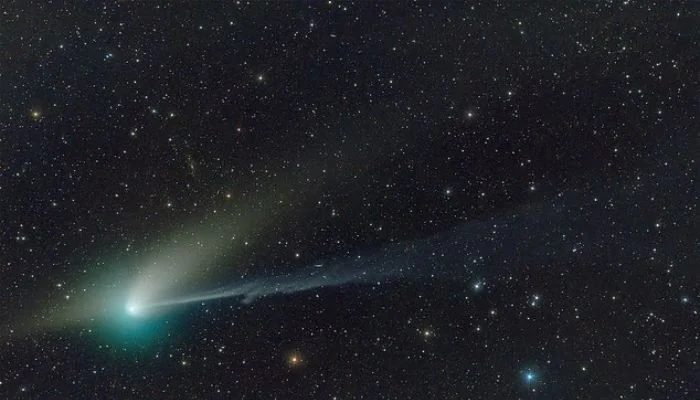
Scientists have raised fresh doubts on a popular theory suggesting some of the building blocks of life on Earth were brought by comets, after discovering that such cosmic objects could have wiped them out upon impact billions of years ago. For years, scientists speculated that comets could have delivered organic compounds to the early Earth, contributing to the evolution of life.
However, a new study by researchers at the University of Cambridge suggests a major flaw in the theory: the comets may have been traveling far too fast for those chemicals to survive the impact. The findings, published in Scientific Reports, are based on 100,000 computer simulations examining what happens when comets collide with a planet.
Researchers focused on compounds such as hydrogen cyanide, which play a crucial role in chemical reactions that produce amino acids, the building blocks of proteins. Their calculations indicate that the extreme heat and pressure generated during most comet impacts would have destroyed these fragile compounds before they could contribute to the emergence of life.
Lead researcher Richard Anslow stated that the possibility of comets delivering the necessary ingredients cannot be ruled out entirely, though it would have required unusually favorable circumstances. The findings also raise questions about whether Mars might have been better positioned to receive such chemicals, given the differing conditions under which comets strike the two planets.
Scientists are now considering whether asteroids played a larger role in delivering organic material to Earth, or if life's ingredients formed here through native chemical processes. While the study does not explain how life began, it casts serious doubt on one proposed route by which its essential ingredients may have arrived.