
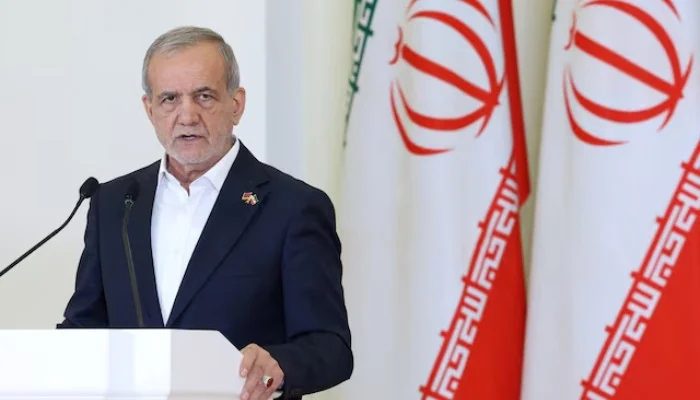
TEHRAN, RIYADH: Iranian President Masoud Pezeshkian said Monday that Tehran remains open to negotiations to end the country's "no war, no peace" situation, stressing that Iran seeks dialogue with the US based on mutual respect but will not surrender to pressure. Speaking at a ceremony, Pezeshkian said Supreme Leader Ayatollah Ali Khamenei had instructed officials to end the state of "neither war nor peace," according to a statement published on the Iranian presidency's website.
"We can negotiate with dignity and resolve the issue with dignity. We favor dialogue and negotiations," he said.
Pezeshkian stressed that logic dictates resolving disputes through negotiations rather than war whenever a country's rights can be secured through dialogue. "However, we will not surrender to force and bullying," he added.
Recalling his address to the UN General Assembly, the president reiterated that Iran seeks negotiations based on justice and equal conditions while refusing to relinquish its rights under pressure. Referring to plots by adversaries to undermine the country, Pezeshkian emphasized the importance of strengthening domestic production and meeting national needs to enhance resilience.
He also called for energy conservation to overcome economic challenges. Meanwhile, a senior security official told state media that Iran has no plans to negotiate with the US unless Washington meets Tehran's seven conditions set in a June interim agreement.
Saudi Arabia's foreign minister and his Omani counterpart stressed in a phone call the need to press ahead with diplomatic efforts to contain the regional crisis and safeguard maritime security, Saudi state media reported. Oil prices fell sharply on hopes for diplomatic talks, with Brent North Sea crude shedding more than 5 percent to $93.32 a barrel, while West Texas Intermediate retreated 4.5 percent to $86.75 a barrel.
Foreign Ministry spokesperson Esmaeil Baghaei defended the plan as the most reasonable offer. Turkish President Recep Tayyip Erdogan said he told Donald Trump that Ankara did not want to see a new escalation, emphasizing that dialogue is the only path forward.
G7 diplomats began a two-day meeting in Paris, with European ministers set to press US Secretary of State Marco Rubio to avoid further escalation. Sunday night's strikes on Qeshm island did not impact vital infrastructure, a provincial official confirmed.
The international community remains focused on these developments as diplomatic channels open. Analysts suggest that the shift in rhetoric from Tehran could signal a strategic pivot aimed at stabilizing the regional economy while maintaining national sovereignty.
As the situation evolves, regional powers are expected to continue their mediation efforts. The upcoming days will be critical in determining whether the proposed negotiations can move beyond preliminary discussions into a formal framework for de-escalation.
The Iranian leadership maintains that its stance is consistent with international law, provided that the rights of the Iranian people are respected and external pressures are removed from the negotiating table.